

 English


The function and classification of communication antenna
Antennas are an important part of wireless communication. What are the working principles and functions of antennas? There are many types of antennas.
Dec . 2025
Do you really trust your current door security to keep you safe at home? Bluetooth often lets hackers inside easily, so you need better protection now. A secure UWB smart lock stops attacks instantly, and you gain true peace of mind. G-NiceRF helps you stay safe and secure today. Discover exactly how this technology works here.

You may currently rely on Bluetooth for your smart home security, but that is a risk. However, standard Bluetooth locks using RSSI ranging are notoriously inaccurate and provide only meter-level ranging. Meanwhile, a UWB smart lock delivers superior 10cm Accuracy which is vastly more precise. That level of precision is a relief for developers and users.
Furthermore, their signals are much more resistant to multi-path interference than legacy wireless protocols. We at G-NiceRF custom design these modules for maximum security and performance. A smart lock with UWB prevents common relay attacks effectively because it uses distance bounding. Bluetooth simply cannot match this performance in complex environments.
You need reliable access control that does not fail. Therefore, upgrading to Ultra-Wideband ensures safety for your residential or commercial applications. It works well in complicated environments where signals bounce off walls. Make the switch to a UWB smart lock for relief.

In order to use these effective modules, you must understand the core technologies behind ultra-wideband security.
You need robust security standards to ensure your system is safe from hackers. The IEEE 802.15.4z protocol defines secure ranging for modern devices. It adds cryptographic features to the UWB smart lock which prevents distance spoofing attacks. Consequently, attackers cannot spoof distance to trick your lock. This standard uses scrambled timestamp sequences (STS) for security.
It ensures data integrity during every transmission. Moreover, UWB enabled smart lock systems rely on this standard to gain protection against manipulation. This standard supports high pulse repetition frequencies, which significantly raises reliability.
System precision is determined by using wide channels for signal transmission. A 500MHz bandwidth generates numerous nanosecond pulses for high resolution. This improves time resolution, which defines the performance of the best UWB smart lock. Other systems work in the narrow band, which is less rapid and accurate. You can distinguish signals clearly even in noisy environments. Likewise, spectral density is lower, which lowers the system's interference with other radios. A large bandwidth grows the system's accuracy to 10cm, which is the best performance.
The continuous wave is the default transmission method for traditional radios. An impulse radio, however, transmits ultra-short pulses, to be exact, 2 nanoseconds or less. This technology lowers the cost of the UWB smart lock price since energy is saved during transmission. It is worth noting that short pulses are less prone to noise interference. This technology is one of the distinct features that use smart locks. It is also more efficient than Wi-Fi for these specific tasks.
Most radios measure signal strength to guess the distance. However, UWB operates in the time domain by measuring signal flight duration. This creates a highly secure UWB door lock for your home. You get exact distance readings based on time. Frequency variations do not affect it like they do with Bluetooth.
Furthermore, time-based ranging is tamper-proof against signal boosters. It ignores signal amplitude changes completely. You receive precise location data every time. This approach defines modern security.
Frequency selection impacts the range of your device significantly. Channel 5 operates at 6489.6 MHz which is a standard UWB frequency. It provides a clean spectrum for reliable communication. Therefore, your UWB smart lock Schlage alternative works well in this band. Interference from Wi-Fi is minimal here because Wi-Fi is usually 2.4GHz. You get stable connections without drops. G-NiceRF modules support this band effectively. Additionally, it balances range and penetration through obstacles. This frequency suits indoor use perfectly. You ensure consistent locking performance.
Component / Feature | Technical Standard / Frequency | Core Mechanism | Security Logic | Signal Characteristic | Performance Metric |
IEEE 802.15.4z | IEEE 802.15.4z Protocol | Scrambled Timestamp (STS) | Cryptographic Anti-Spoofing | High Pulse Repetition | Data Integrity Verified |
500MHz Bandwidth | 500MHz Wide Channel | High Resolution Timing | Low Spectral Density | Nanosecond Pulses | 10cm Ranging Accuracy |
Impulse Radio | Ultra-Wideband | Discrete Transmission | Noise Interference Rejection | < 2ns Pulse Width | High Energy Efficiency |
Time Domain | Time of Flight (ToF) | Signal Flight Duration | Anti-Signal Boosting | Amplitude Independent | Precise Location Data |
Channel 5 | 6489.6 MHz | 6.5GHz Spectrum | Wi-Fi Interference Immunity | Obstacle Penetration | Zero Connection Drops |
Technical Specifications and Performance Metrics of UWB Smart Lock Systems!
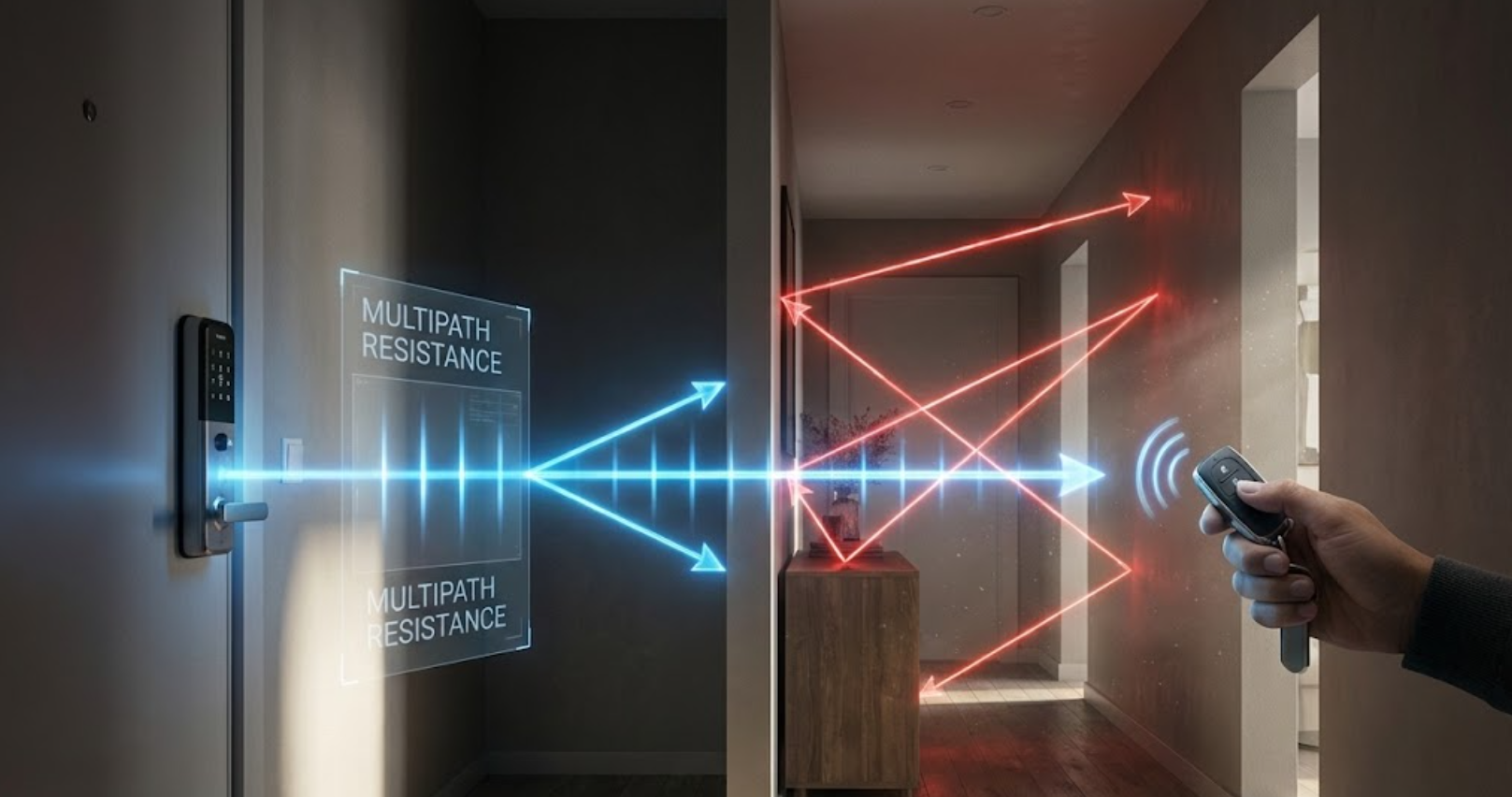
You will discover five critical advantages where ultra-wideband technology completely surpasses legacy Bluetooth wireless protocols.
Bluetooth estimates distance poorly because it uses signal strength. In contrast, UWB measures actual flight time of the signal. Signals travel at the speed of light, which is constant. Therefore, the UWB smart lock calculates distance precisely based on physics. You get millimeter-level data in some cases.
RSSI cannot achieve this level of accuracy ever. Moreover, time of flight is absolute and reliable. Environmental factors change little regarding speed. The UWB smart lock price reflects this value. You trust the physics behind it. Calculations happen instantly.
Signals bounce off walls, and this can confuse standard radios like Bluetooth. However, the pulses sent by UWB smart locks are extremely short and distinct. The receivers can separate their own direct signals from the echoes. Competitors of the Schlage UWB smart lock work this way to avoid false unlocks.
Multipath fading does not stop it from working. Furthermore, the best UWB smart lock ignores clutter in the room. Your entry is secured regardless of furniture. Complex environments offer no issue for UWB.
Bluetooth can vary by meters when in use, which is dangerous. Conversely, UWB can offer 10cm accuracy for positioning. This is the precision that defines UWB smart locks today. You know exactly who approaches the door with this tech. It can also distinguish someone standing in the area outside versus inside. This means that security is tightened significantly for everyone.
A UWB door lock is designed to stay locked appropriately when you are inside. You avoid accidental openings completely. This is the granularity that makes hands-free operation possible.
Most waves use a continuous sine wave when in use. UWB is different as its pulses are non-sinusoidal and look like noise. This means that a UWB enabled smart lock is considered covert and hard to find. It is extremely noisy to hackers who may be trying to intercept it. You gain a stealthy layer of protection. Additionally, the high energy of the pulses punches through interference. The signal structure is robust against jamming. You benefit from inherent security.
Devices are always fighting for space and air in your home. Bluetooth is easy to get crowded, but UWB works with dense air tags. Your UWB smart lock Schlage system is able to manage traffic easily. TDoA algorithms manage systems from multiple users simultaneously.
Furthermore, short pulses clear airtime quickly for the next signal. You can track many keys at once. System capacity remains high. Rarely do network collisions happen. High capacity is great for buildings.
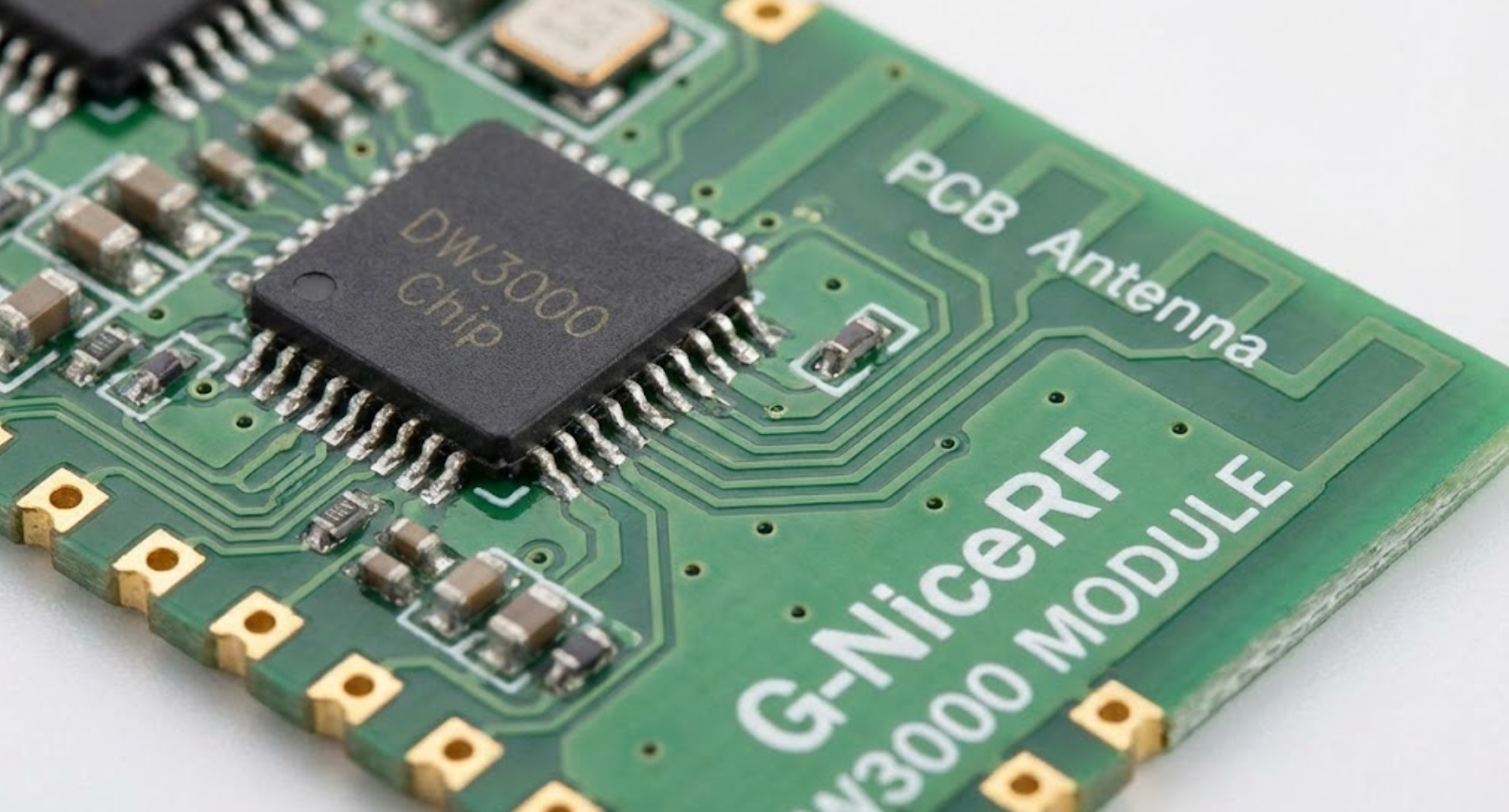
It is time for you to address particular hardware attributes that influence and drive effectiveness in G-NiceRF’s module.
Performance usually starts from the core chip you choose. People in the industry know that we use the Qorvo DW3000 chip. It supports IEEE 802.15.4z standards, which ensures that your UWB smart lock is compliant. It is an economic, low-power chip for modern devices. Most UWB devices sit idle for long periods. You receive the most notable commercial silicon available. Consequently, your access control is powered with state-of-the-art technology.
Timing for this technology is crucial for accuracy. It has to be stable, and a TCXO Oscillator guarantees that. Your best UWB smart lock can stay accurate over time. You need to use nanoseconds, which you won’t get from regular crystals. To top it off, the TCXO keeps the clock stable. Synchronization is preserved perfectly. You always ensure there’s reliable continuous operation.
Most standard chips lack power for long range. But our UWB3000F27 provides a 500mW Amplifier for better reach. This increases the range to 1.5km in open space. As a result, the UWB door lock connects even further than before. You gain control over remote gates easily. A stronger signal increases reliability significantly. Also, UWB smart locks require link margin. This amplifier increases reliability over heavy obstacles. Long-range security is now possible.
Antenna design determines signal shape and quality. A PCB Antenna is integrated for this reason on our modules. It is space-efficient on the board for small designs. Thus, the UWB enabled smart lock is more compact. No external parts are required for the antenna. Performance in signal reception is omnidirectional. We also tune it perfectly for UWB. It aligns to the 6.5GHz band. You are given consistent patterns in radiation. Simple installation is the result.
Weak pulses need boosting to be heard. It helps considerably for a signal to be amplified. This is where LNA Integration comes in for the UWB3000F27. It amplifies received pulses for the smart lock receiver.
Hence, the UWB smart lock Schlage rival hears more clearly. This grants more sensitivity to the system. You can now detect the tag from a farther range. It also considerably lowers the noise floor. This improves the functioning of the receiver. As a result, communication is more efficient.
You can also prevent advanced signal hacking attempts using very specific distance-bounding security measures.
- Distance Bounding: UWB smart lock verifies exact distance.
- Timestamp Verification: Checks signal time for UWB smart locks.
- Scrambled Timestamp: Best UWB smart lock randomizes codes.
- AES128 Encryption: UWB enabled smart lock secures data.
- Physical Proximity: UWB door lock confirms user presence.
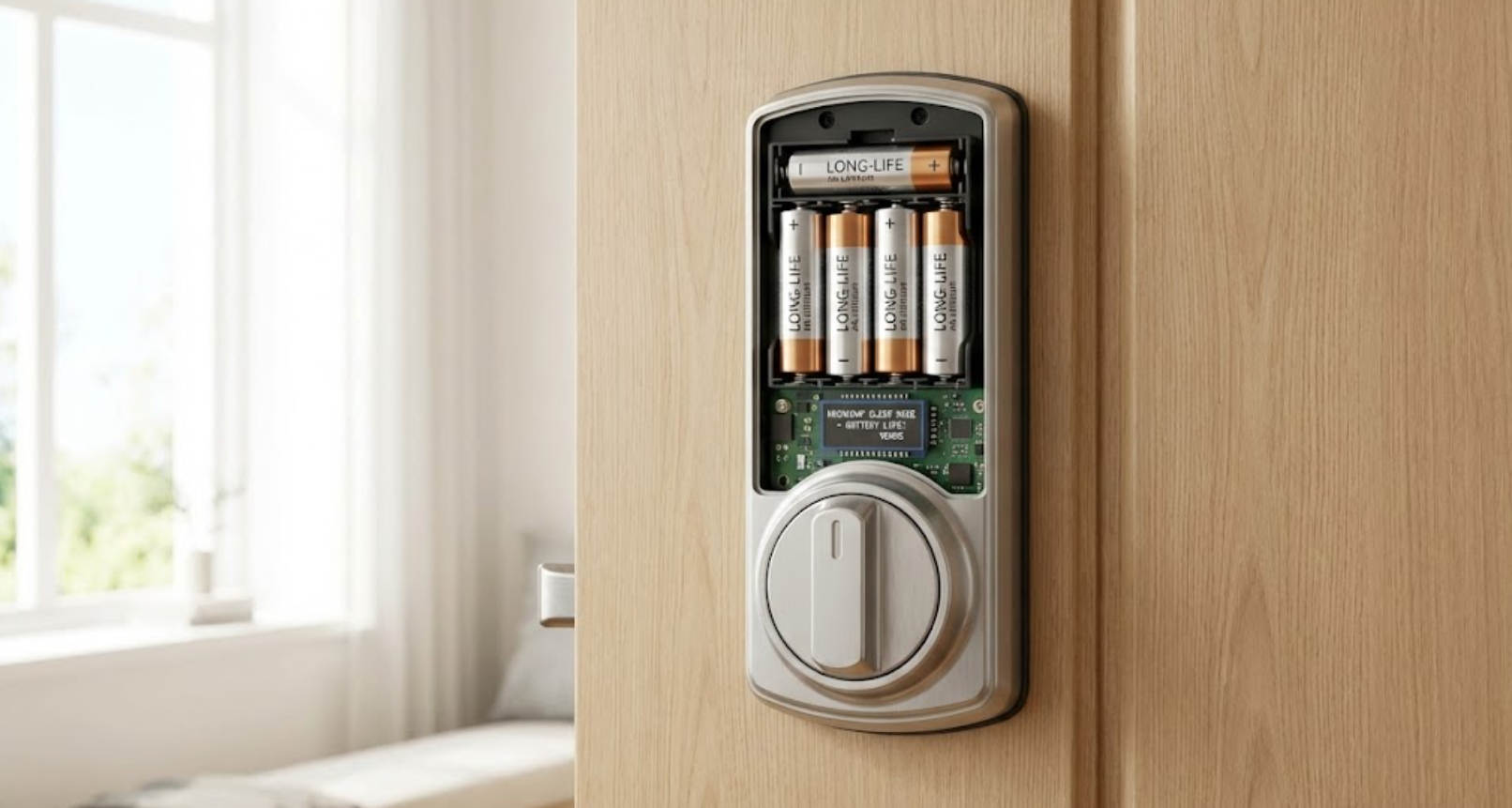
These power management techniques must be used to ensure your lock’s battery lasts for years.
Batteries must last for years in locks. Our modules implement microamp sleep to save power. During this sleep, the current drops below 100uA. Thus, the UWB smart lock retains power, stretching battery replacement cycles. High currents drain cells fast if not managed. The chip wakes instantly to check usage then sleeps. The UWB smart lock price reflects this efficiency. You also reduce upkeep costs.
Constant transmission cycles are huge power wasters. However, with intermittent pulses, the radio only fires when it’s necessary. Thus, the best UWB smart lock conserves battery life effectively. You set the rate of pulses to balance speed versus power. Idle times are long for the device. The UWB smart door lock rests frequently. You have optimized the system logic.
The primary radio is poised to enter sleep. A wake-up radio helps with that process. It listens for a trigger signal, and that is why UWB smart locks sleep. More energy is saved when the UWB component activates late. By using a 125kHz module, the battery life is easily preserved. You use a tiered approach to power.
How efficiently a system operates is based on voltage. A 3.3V Supply is standard for these modules. It powers the DW3000 chip effectively. For that reason, the Schlage UWB smart lock alternative operates with a low temperature. Wasting heat is a concern with higher voltage levels. You consider the outputs of the battery carefully. Regulators are efficient at this voltage. Power loss stays constant. The system reliably operates. You consider the standard lithium cells.
Static sleep results in sleep waste over time. With dynamic sleep, the system adjusts itself. The lock detects inactivity for a certain period of time. As a result, the UWB enabled smart lock goes into a longer sleep. It stays in sleep mode for longer periods at night. You define the time intervals for wakeup. When active, the system adapts to the power usage. The energy used is controlled greatly. We call that power management.
This section is meant to answer the most common technical questions regarding ultra-wideband integration.
Energy efficiency is critical for battery devices. The sleep current is in the microamp range. Specifically, modules like the UWB650Pro have a sleep current below 100μA. Therefore, the UWB smart lock lasts long. Deep sleep preserves your battery life. You can expect years of service. Furthermore, our modules optimize this consumption. The UWB smart lock price accounts for this. You get a low-power solution. Standby drain is negligible.
Many people ask about visibility requirements. UWB penetrates many materials like wood. It passes through wood doors easily. Therefore, UWB smart locks work hidden inside the door. You do not need line-of-sight for it. Metal does block signals significantly. However, standard walls are fine for transmission. The UWB enabled smart lock is robust. You get reliable unlocking every time. It works from inside pockets.
Interference is a common worry for developers. Yes, UWB coexists with Wi-Fi easily. It uses a different spectrum entirely. Therefore, the best UWB smart lock is safe to use. Wi-Fi uses narrow 2.4GHz bands usually. UWB spreads across 500MHz bandwidth. Furthermore, the noise floor is low. UWB door lock signals are distinct. You experience no network slowdowns.
Developers want connectors that are easy to use. SPI and UART are industry standards. Our devices support both interfaces. So, integration of the UWB smart lock Schlage type is quick. You can connect to any MCU you want. With UART, data transfer is straightforward. For superfast speeds, use SPI. Pick whichever works for your use case. Very easy integration is possible. High hardware compatibility is key.
Security is important, and accuracy ensures it. Yes, ToF is more accurate than RSSI. RSSI measures the signal strength, but that varies. For the UWB smart lock, however, it times the emitted and reflected pulses. Schlage UWB smart lock systems do this, providing accuracy to within 10cm. With RSSI, inaccurate readings are typically in the order of meters. ToF provides true proximity.
Bluetooth cannot match this new technology because you need precision and safety at home. Upgrading to a UWB smart lock solves many problems, and hackers cannot break these secure systems. You enjoy long battery life too. Visit G-NiceRF for more details. We help you build better products today. Please start your new project right here online.
 +86-755-23080616
 sales@nicerf.com
Website: https://www.nicerf.com/
Address: 309-315, 3/F, Bldg A, Hongdu business building, Zone 43, Baoan Dist, Shenzhen, China


Privacy Policy
· Privacy Policy
There is currently no content available
Email:sales@nicerf.com
Tel:+86-755-23080616