

 English


How to choose LoRa module
There are many types of LoRa modules on the market, and the quality is good or bad. So how do we choose LoRa wireless modules and which manufacturer i
Oct . 2025
Full Duplex Communication (FDX) is like a face-to-face conversation—both parties can talk and listen at the same time, without waiting for the other to finish.
We actually experience full duplex technology every day. The most classic example is a phone call—you can interrupt at any time, unlike using a walkie-talkie, where you have to say "over." Today's wired networks, video conferencing software, and even the online games you play rely on full duplex communication to ensure smooth, real-time interaction. It's no exaggeration to call it a cornerstone of modern communication.
To better understand full duplex, let's look at the other two communication modes: simplex and half duplex.
You can think of simplex, half duplex and full duplex as three different ways of chatting.
Simplex: This is like listening to the radio or watching the TV news. The signal can only go from the station to you; you can't talk back. This path is strictly a "one-way street."
Half Duplex: This is like using a walkie-talkie. You can both talk, but not at the same time. You have to press the button to talk, then release it to listen. Although it's two-way communication, the channel is shared, so you have to take turns.
Full Duplex: This is like our usual phone calls; you can talk and listen simultaneously, and so can the other person. In this way, the same channel effectively becomes two independent lanes, allowing data to travel in both directions at the same time, naturally doubling the efficiency. This is what makes full duplex so powerful.
Deciding which "chat" mode to use is a rule set at the lowest level of communication (the physical layer). Therefore, a device's mode—whether it can "chat simultaneously" or must "chat in turns"—is fixed when it leaves the factory.
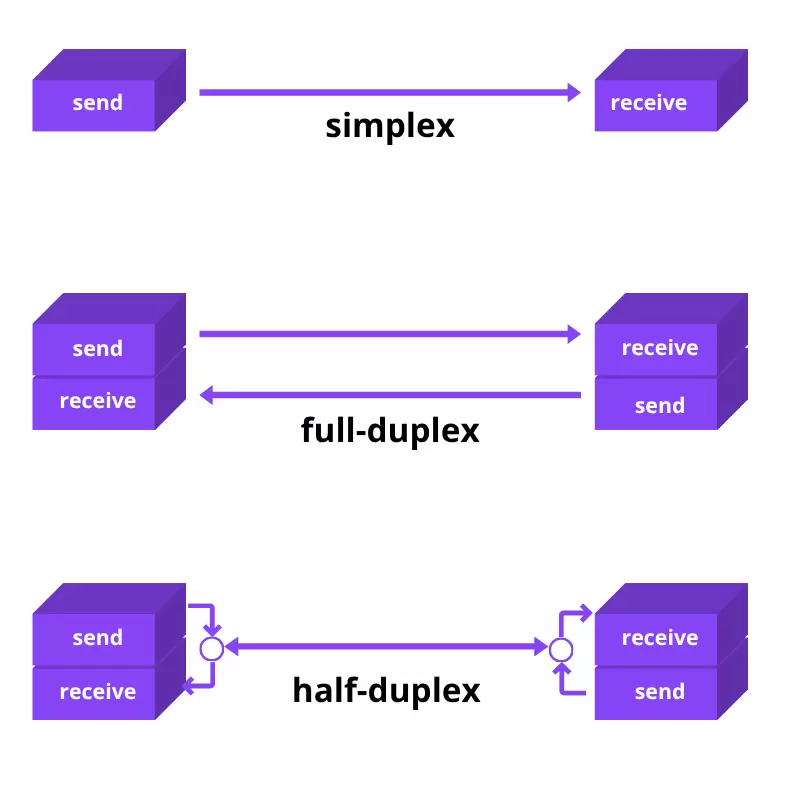
Characteristic | Simplex | Half Duplex (HDX) | Full Duplex (FDX) |
Data Direction | One-way | Two-way | Two-way |
Simultaneity | N/A | Non-simultaneous | Simultaneous |
Channel Occupation | One device transmits | Two devices share, alternating | Two devices transmit simultaneously |
Performance | Lowest channel utilization | Medium utilization involves turnaround time | Highest channel utilization, no turnaround time |
Typical Example | Radio broadcast, Pager | Walkie-talkie, Hub-based Ethernet | Telephone call, Switched Ethernet |
Core Limitation | No return path | Channel contention, Latency | System complexity, Self-interference |
To achieve full duplex (talking and listening at the same time), a device must solve one problem: "self-interference."
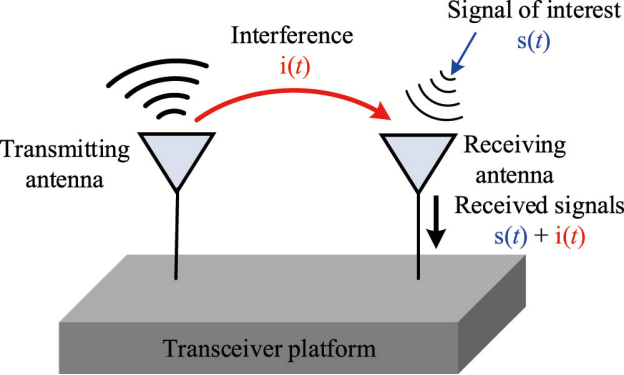
What is self-interference?
Simply put, the problem is this: you can't "shout into a megaphone" (transmit a signal) and still expect to "hear a pin drop" (receive a signal) at the same time.
How serious is the problem? A device's own "shout" (transmit, TX) can be 10 billion times stronger (technically 100 dB) than the faint signal it's trying to "hear" (receive, RX).
What is the result? Without any processing, this massive "shout" will completely "drown out" the faint "listening" signal, making it impossible to hear anything.
Therefore, the solution is to efficiently isolate the "shouting" (TX) and "listening" (RX) signals.
To solve this, engineers primarily use two clever methods to "isolate" the signals, ensuring that talking and listening don't interfere with each other:
Separate "Lanes" (FDD - Frequency Division Duplex): This is like building a completely separate elevated highway for transmitting and receiving; they communicate on different frequencies.
Separate "Time Slots" (TDD - Time Division Duplex): Transmitting and receiving share the same road but strictly follow a traffic light. The system switches between "talking" and "listening" at a speed so fast (imperceptible to humans) that it feels simultaneous.
The next two sections, 2.1 and 2.2, will detail how these two technologies are implemented.
FDD uses the most direct method to avoid self-interference: using two independent frequency channels, one dedicated to "talking" (transmitting) and the other to "listening" (receiving). Between these two frequency channels, there is also a "Guard Band"—like a central divider on a highway, ensuring the signals do not interfere with each other, a key requirement for Full Duplex Communication.
Core Component: Duplexer
Early mobile phones typically had only one antenna but needed to handle both "talking" and "listening" signals simultaneously. The "Duplexer" is the core component that solves this problem. It is usually connected to the device's common antenna port.
It is a passive, frequency-based filter combination whose intelligence lies in its ability to precisely control signal flow in both directions at once:
It directs the powerful transmit signal (from the "megaphone") only to the antenna.
It directs the weak receive signal (from the "antenna") only to the receiver.
In this way, it ensures that the transmit signal (from the "megaphone") does not "leak" and "drown out" the sensitive receiver ("ear").
Advantages: Because transmitting and receiving each have their own dedicated, always-open channels, data transmission latency is very low and stable. This is ideal for applications requiring immediate responses, such as phone calls and video conferences.
Disadvantages: It requires occupying two separate frequency bands, which doubles the cost in terms of scarce spectrum resources. Secondly, the duplexer adds to the device's size.
TDD (Time Division Duplex) takes a different approach to Full Duplex Communication. It lets "talking" (transmitting) and "listening" (receiving) share the same frequency channel, but strictly alternates them in time. The system switches at high speed between "transmit time slots" and "receive time slots," separated by a brief "guard interval."
The core components of the TDD method are a very fast RF switch and a highly precise, synchronized clock. This switch is responsible for physically switching the antenna's connection between the transmit (TX) and receive (RX) circuits, like an extremely responsive traffic light.
TDD's main advantage is its high spectral efficiency, as it only occupies one channel (FDD needs two). It's also flexible, allowing for dynamic bandwidth allocation (e.g., 70% of the time for downloading, 30% for uploading). However, its disadvantages are also clear: the constant switching introduces a small amount of latency. More critically, TDD requires precise time synchronization across the entire network (often via GPS) to ensure one device's "talking" doesn't conflict with another's "listening" and cause interference.
FDD and TDD are not enough to achieve true full duplex communication. Because a device's own transmit (TX) signal is so powerful, even with the basic isolation from FDD (duplexer) or TDD (time switching), some signal will still "leak" into the sensitive receive (RX) path. This residual self-interference is still strong enough to "drown out" the weak signal you actually want to receive.
Therefore, engineers use "noise cancellation" techniques to eliminate this "leaked" interference in three domains:
Propagation Domain (Physical Isolation): This is like placing the "megaphone" (transmitting antenna) and "microphone" (receiving antenna) far apart and facing different directions, providing an initial physical reduction in interference.
RF Domain (Analog Cancellation): This is like wearing "noise-canceling headphones." The system samples its own "shout" and then creates an identical but phase-inverted "anti-noise" signal to cancel it out before the signal enters the amplifier.
Baseband Domain (Digital Cancellation): This is the "final clean-up." The system uses computer algorithms to mathematically "subtract" the last bit of residual "echo" (including distortion) from the received data after the first two steps.
An advanced Full Duplex Communication system will use all three of these techniques simultaneously to achieve efficient and reliable "talking and listening at the same time."
Full Duplex Communication technology is the foundation for almost all modern communication infrastructure.
The most classic example is the telephone. Whether it's an old landline or a modern smartphone call, both allow parties to speak and listen simultaneously, the definition of Full Duplex Communication.
The use of full duplex in computer networks (like Ethernet) is also a key example.. Early "shared" networks (hub-based) were like a walkie-talkie; everyone shared one channel and had to take turns speaking (half duplex). Modern networks (switch-based), however, create a dedicated channel for each computer, like a private phone line, allowing data to be sent and received simultaneously (full duplex), which greatly increases network speed.
Furthermore, 4G and 5G Mobile Networks also flexibly use full duplex communication technology. They intelligently choose to use either FDD (more stable, low latency) or TDD (more spectrum-efficient) schemes to achieve high-speed data transmission, based on available spectrum resources and policies.
Professional wireless modules are hardware components that package core technologies like full duplex communication, mesh networking, and noise cancellation into a practical, usable form.
These modules do more than just one-to-one communication. For example, modules like the SA618F22 or SA628F30 can handle 8 concurrent conversations and form a "mesh network" (MESH). In such a network, each device can help relay signals for others, extending the communication range. This requires very precise time synchronization and smart resource allocation to prevent conflicts.
These modules offer different performance configurations for various uses. For instance, some are low-power (like the SA618F22 at 160mW), while others can reach 8W (like the SA628F39) to ensure long-distance communication. They operate in specific frequency ranges (e.g., 410-480 MHz) and provide different types of connections (interfaces). Some are specialized for audio (I2S interface), while others are used for transmitting control commands or sensor data (UART interface), such as the SA618F30-FD, which is focused on data transmission.
This hardware solves the problems discussed in section 2.3. They have built-in algorithms to eliminate echo and also integrate AES128 encryption (a feature in the SA628F30 module) and ESD hardware protection. These designs, which are fundamental to full duplex walkie talkies and other products, ensure that communication remains clear, secure, and reliable even in noisy, harsh environments.
If you want to know the detailed specifications, selection guide, and practical applications of full-duplex modules, you can read this article for more information:
Full duplex communication can provide much higher throughput and lower latency than half duplex, but achieving these benefits requires more complex algorithms and hardware.
The core advantage of full duplex communication is that it doubles the theoretical throughput. Because it allows data to "come and go" simultaneously, the total amount of data that can be transmitted under the same conditions is naturally twice that of half duplex.
Another key advantage of full duplex communication is the elimination of "turnaround time." Half duplex (like a walkie-talkie) always has a slight pause when switching between "talking" and "listening." This switching process (which can take tens of milliseconds) wastes time and can feel laggy. Full duplex virtually eliminates this delay by keeping the channel open in both directions.
This no-delay characteristic improves interactivity, making applications like phone calls, video conferences, and remote operations feel much smoother.
However, achieving full duplex communication comes at a cost. The main challenge lies in "complexity"; both the hardware (like the high-performance duplexers needed for FDD) and the software (like the complex echo cancellation algorithms) introduce higher technical demands.
These complex algorithms require significant processing power (e.g., from a DSP or FPGA), which in turn increases power consumption. This is a significant challenge for battery-dependent mobile devices like phones.
Furthermore, spectrum cost is a key constraint. The FDD scheme requires two separate spectrum blocks, which is expensive. The TDD scheme, while more flexible in spectrum use, introduces extra latency and synchronization overhead.
Therefore, full duplex communication is not the optimal solution for every scenario. In many simple applications, such as a sensor that only needs to report data occasionally or a one-way control command, a simpler, lower-cost half duplex system is a more appropriate choice. The core value of full duplex communication technology is primarily in applications with a strict need for real-time, two-way interaction, such as voice calls or remote control.
Modern communication systems increasingly adopt full duplex communication to support real-time, bidirectional traffic, whereas early systems used simplex or half duplex due to hardware or spectrum limitations. The primary engineering challenge has shifted from merely achieving two-way communication (solved by half duplex) to achieving simultaneous two-way communication efficiently and economically. The principles of FDD and TDD are now mature and form the foundation of our current global full duplex communication networks.
However, the quest for even greater spectral efficiency continues. A major goal in the industry is "In-Band Full Duplex" (IBFD). This technology aims to transmit and receive at the "same time and on the same frequency," which in theory could double the spectral efficiency compared to TDD or FDD.
Of course, the self-interference challenge for IBFD is enormous (requiring 110 dB+ of cancellation, including modeling the distortion from the device's own power amplifier), but this is precisely a key research focus for 5G-Advanced and 6G networks. If successfully implemented, the benefits of IBFD would extend beyond just doubling throughput; it could also significantly reduce latency (as a device could receive an acknowledgment instantly) and even improve network security (by allowing a device to "listen" for jammers while transmitting).
 +86-755-23080616
 sales@nicerf.com
Website: https://www.nicerf.com/
Address: 309-315, 3/F, Bldg A, Hongdu business building, Zone 43, Baoan Dist, Shenzhen, China


Privacy Policy
· Privacy Policy
There is currently no content available
Email:sales@nicerf.com
Tel:+86-755-23080616