

 English


Contact us
HOME > ABOUT US > PRODUCT INFORMATION > A GUIDE TO SELECTING LORA MODULES AND SUPPLIERS FO...
A Guide to Selecting LoRa Modules and Suppliers for the Indian Market in 2025
15
Oct . 2025
By NiceRF Team
Updated: Oct 15, 2025
Entering the Indian Market: What Are the First Questions to Ask?
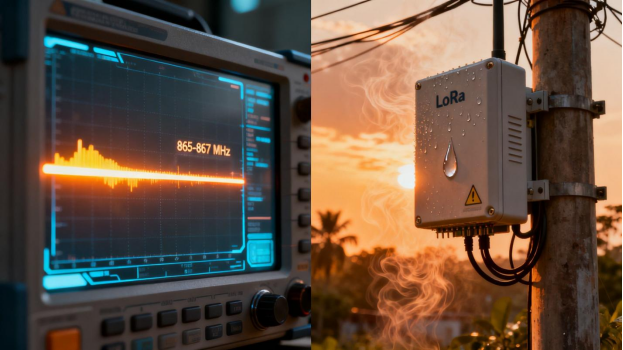
When deploying LoRa devices in India, the primary prerequisite is to comply with local regulations and environmental conditions. India has allocated a dedicated license-free band of 865–867 MHz for LoRa, and many parts of the country face typical environmental challenges such as high temperatures, high humidity, or dust. Ensuring that modules operate compliantly and reliably under these conditions is the foundation for all subsequent selection efforts. To learn more about the specific regulations and environmental challenges in India, please read our feature article: "A Deployment Guide for LoRa in the Indian Market: Frequency Compliance and Environmental Challenges."
Frequency Compliance: How Do We Ensure Our Devices Operate Legally in the 865–867 MHz Band?
The Indian government has designated the license-free ISM (Industrial, Scientific, and Medical) band from 865 MHz to 867 MHz for low-power wide-area network technologies like LoRa. It is important to note that its 2MHz bandwidth is much narrower than the 7MHz bandwidth commonly used in Europe. Therefore, many "868 MHz" modules on the market may have default channels that fall outside India's permitted frequency range if not properly configured.
For system integrators and product developers, the first task is to confirm that the chosen module not only supports the 865-867 MHz frequency range in hardware but, more importantly, that its firmware and software development kit (SDK) provide precise and reliable frequency configuration capabilities. Developers must be able to easily restrict the module's operating channels strictly within the legal 2 MHz bandwidth and lock these configurations to prevent any accidental out-of-band transmissions.
Facing India's Heat and Humidity: How Can We Guarantee Module Stability?
India's diverse geography and climate pose significant challenges to electronic devices. An industrial-grade specification (-40°C to +85°C) is a basic guarantee. Among these, temperature fluctuations have the most direct impact on communication link stability, and the Temperature Compensated Crystal Oscillator (TCXO) is key to addressing this challenge. A TCXO can actively correct frequency drift caused by temperature changes. For high-reliability applications deployed in India (such as utility metering and critical infrastructure monitoring), it is recommended to choose modules equipped with a TCXO to mitigate environmental risks.
Starting from the Application: How to Choose Based on Different Needs?
IoT applications in India span urban, rural, and industrial areas, with significantly different requirements. From smart meters to agricultural sensors and cross-border logistics tracking, different scenarios have varying demands for communication distance, power consumption, and integration. The selection should start with the specific use case. You can read our article:"Smart Metering, Smart Agriculture, Asset Tracking: Which Category Fits My Project and How Do I Choose a Module?" for a more detailed scenario analysis.
Scenario 1: Smart Metering and Industrial Applications
For Automated Metering Infrastructure (AMI) and industrial automation applications, the core requirements are long battery life (10-15 years) and reliable signal penetration. In this case, the module's sleep current (≤1µA) and high receiver sensitivity (-141dBm to -148dBm) are crucial. For large-scale deployments, the stability and system-level robustness of the module's firmware are equally important, as they directly impact the project's Total Cost of Ownership (TCO).
Scenario 2: In Vast Farmlands, How to Balance Coverage and Cost?
Smart agriculture applications require deploying a large number of sensors over vast areas. The primary goal is to maximize communication distance to reduce gateway costs. Adopting an asymmetrical architecture is a cost-effective strategy: use high-power modules (e.g., +33dBm) on the mains-powered gateway side and standard-power modules (e.g., +22dBm) on the battery-powered node side. This ensures network coverage while maximizing the battery life of the end nodes.
Scenario 3: Cross-Regional Asset Tracking
The complexity of asset tracking lies in its mobility and the need to switch between multiple network environments. Modules that integrate multiple communication technologies (Sub-GHz LoRa, 2.4 GHz LoRa, S-Band satellite communication) and positioning functions (GNSS, Wi-Fi scanning) are the ideal choice. Such highly integrated modules can greatly simplify hardware design, reduce BOM costs, and enable smarter collaborative power management.
Let's Talk Core Performance: How Far Can the Signal Go, and How Long Can the Battery Last?
Parameter comparison shouldn't stop at the datasheet. In actual deployments in India, link budget and battery life depend on the combined performance of transmit power, receiver sensitivity, data rate, and duty cycle. For a detailed guide on how to accurately calculate and balance these performance metrics, please refer to our article "How Far Can a Signal Go? How Long Does a Battery Last? Let's Talk About the Core Performance Trade-offs of LoRa Modules".
How Far Can the Signal Go? A Look at Transmit Power and Receiver Sensitivity
The link budget is the fundamental basis for evaluating coverage range. The 11dB power difference between a standard power module (+22dBm) and a high-power module (+33dBm) can theoretically increase the communication distance by about 3.5 times. At the same time, receiver sensitivity is inversely proportional to the data rate. When evaluating, one should not only look at the best-case value but also analyze the sensitivity performance at the data rate required by the actual application.
How Long Can the Battery Last? A Detailed Breakdown of Power Consumption
For battery-powered devices, the total energy consumption is the integral of current over time across various operating states (sleep, receive, transmit). "Time-on-Air" is a key variable, determined by the data rate. A module that can send a data packet at a faster rate will consume less total energy, even with the same peak current, because it can return to sleep mode more quickly.
Table 1: Technical Specifications Comparison of Representative LoRa Modules
Parameter | LoRa126X (SX1262/8) | LoRa126XF30 (SX1262/8) | LoRa1121 (LR1121) | LoRa-STM32WLE5(STM32WLE5) |
Core Chip | Semtech SX1262/SX1268 | Semtech SX1262/SX1268 + PA | Semtech LR1121 | STMicroelectronics STM32WLE5 |
Architecture | Standard Module (needs external MCU) | High-Power Module (needs external MCU) | Multi-Band Module (needs external MCU) | System-on-Chip (SoC) |
Freq. Range (MHz) | 150-960 (configurable for 865-867) | 150-960 (configurable for 865-867) | Sub-GHz (150-960), 2.4GHz, S-Band | 150-960 (configurable for 865-867) |
Max Tx Power (dBm) | +22 | +33 | +22 (Sub-GHz), +10 (2.4GHz) | +22 |
Rx Sensitivity (dBm) | -148 (best case) | -148 (best case) | -145 (Sub-GHz), -132 (2.4GHz), -130 (S-Band) | -141 (best case) |
Operating Voltage (V) | 1.8 - 3.7 | 3.0 - 6.5 | 1.8 - 3.6 | 1.8 - 3.6 |
Operating Temp. (°C) | -40 to +85 | -40 to +85 | -40 to +85 | -40 to +85 |
Tx Current | ~110mA @ +22dBm | ~550mA @ +33dBm | ~110mA @ +22dBm (Sub-GHz) | ~90mA @ +22dBm |
Rx Current | ~5mA | ~5mA | ~5.5mA | ~7mA |
Sleep Current | ~2µA | ~2µA | ~1.5µA | ~1µA |
Key Differentiator | Balanced performance, optional TCXO | High power for gateways & long range | Multi-band/function (terrestrial, satellite), supports LR-FHSS | Integrated MCU (Cortex-M4), smaller size & BOM |
At the Design Crossroads: How to Choose an Architecture and Protocol?
Besides RF and power consumption, architecture choice and protocol support are equally critical. Should you use an external MCU for flexible development or an SoC to reduce costs? Do you need to plan for future network congestion? These questions determine the product's scalability and lifecycle. For more discussion on architecture and long-term strategy, see "Behind a Successful LoRa Project: How to Make the Right Architecture and Supplier Decisions?".
"External MCU" or "All-in-One" SoC?
Standard Module + External MCU: Provides full flexibility, allowing reuse of existing code and toolchains. Ideal for rapid prototyping, low-to-medium volume production, or projects with specific MCU requirements.
SoC (System-on-Chip): Integrates the MCU and RF unit in a single package. It can significantly reduce BOM cost and product size, making it ideal for cost-sensitive, high-volume applications (like utility metering).
What if the Network Gets Crowded? Getting to Know LR-FHSS
Long-Range Frequency Hopping Spread Spectrum (LR-FHSS) technology aims to increase network capacity and interference resistance by rapidly hopping across multiple frequency channels to transmit data packets. For long-lifecycle, high-node-density projects, choosing a module that supports LR-FHSS is an important strategy to ensure long-term network scalability and stability.
From Sample to Mass Production: Long-Term Factors to Consider in Selection
Expanding from a pilot of a few hundred units to a large-scale deployment of one hundred thousand units tests not just the module itself, but the reliability of the entire system and the support capability of the supplier.
Why is 'Invisible' Software Reliability More Important?
A mature firmware should have multiple protection mechanisms to ensure the system runs reliably under harsh conditions like unstable power or strong electromagnetic interference. In large IoT networks, a minor firmware defect can lead to huge operational costs. Therefore, it's essential to deeply understand the module's firmware maturity, field deployment history, and specific protection mechanisms.
Choosing a Module is Choosing a Partner: How to Evaluate a Supplier's Partnership Model?
Choosing a module supplier is essentially about selecting a long-term engineering and supply chain partner. Beyond technical specifications, what truly matters is the supplier’s ability to provide real-world project support—such as ensuring stable operation in complex environments, enabling large-scale deployments that remain reliable over time, and offering continuous guidance from prototyping to mass production.
Suppliers like G-NiceRF, which have long specialized in long-range, low-power wireless modules, possess extensive experience in maintaining stability across large deployments under challenging conditions. Such capabilities often have a more direct impact on project success than a mere 1 dB difference in sensitivity on the datasheet.
A dependable partner ultimately translates into lower development risks and higher implementation certainty.
Contact Us
 +86-755-23080616
 sales@nicerf.com
Website: https://www.nicerf.com/
Address: 309-315, 3/F, Bldg A, Hongdu business building, Zone 43, Baoan Dist, Shenzhen, China
Related Products