

 English


Contact us
HOME > ABOUT US > PRODUCT INFORMATION > BEHIND A SUCCESSFUL LORA PROJECT: HOW TO MAKE THE ...
Behind a Successful LoRa Project: How to Make the Right Architecture and Supplier Decisions?
15
Oct . 2025
By NiceRF Team
Updated: Oct 15, 2025
When you're picking a LoRa module, do you feel like you're done after comparing the RF and power consumption specs? In reality, that's just the first step. Whether a LoRa project can be truly successful often depends on the "invisible" decisions: What product architecture should I choose? What happens if the network gets congested in the future? How should we view our relationship with suppliers?
In this article, we'll talk about these topics that are just as important as the hardware parameters.
The Architecture Crossroads: 'External MCU' or 'All-in-One' SoC—How Should I Choose?
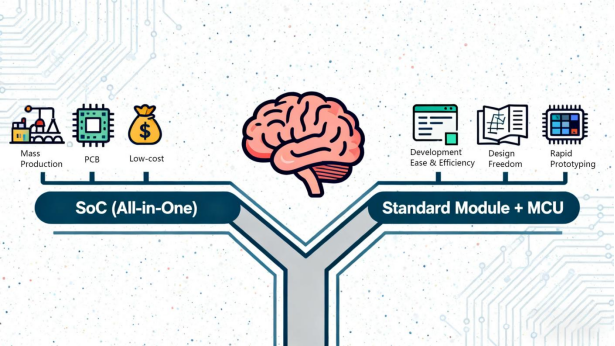
This is a classic question, and the answer depends on your project goals and your team's situation. LoRa modules on the market mainly fall into two hardware architectures: "standard modules" that need an external microcontroller (MCU) to drive them, and "System-on-Chip" (SoC) modules that come with their own MCU.
Choosing which path to take is essentially a trade-off between "flexibility and development speed" and "integration and long-term cost."
If you're aiming for flexibility and a fast time-to-market (Standard Module + External MCU path):
This path offers product developers complete freedom. Your team can choose the MCU platform they are most familiar with or that is already standardized within your company (like STM32, NRF, ESP32, etc.), allowing you to reuse existing codebases, software toolchains, and development experience. This usually shortens the product development cycle significantly and is the ideal choice for rapid prototyping, low-to-medium scale production, or projects with specific MCU performance requirements.If your goal is mass production and cost control (SoC path):
Choosing the SoC solution means your development team will need to develop software around the module's integrated MCU, which might involve a learning curve initially. However, its huge advantage becomes apparent in the mass production phase. By eliminating a separate MCU chip, the SoC solution can significantly reduce the Bill of Materials (BOM) cost per unit and achieve a more compact product size. For extremely cost-sensitive and high-volume applications (like utility metering or bike-share locks), the SoC architecture has a clear cost advantage.
What to Do When the Network Gets Crowded? Is It Necessary to Understand LR-FHSS Technology?
You might be worried that as more and more IoT devices come online, the limited license-free frequency bands will become increasingly congested. What about signal collisions? This is precisely the problem that Long-Range Frequency Hopping Spread Spectrum (LR-FHSS) technology is designed to solve.
In simple terms, LR-FHSS technology slices a data packet into many small pieces and then sends them out by rapidly "hopping" across multiple different frequency channels. The benefit is that even if one channel has interference, it will only affect a small portion of the data, rather than causing the entire packet to be lost.
Although standard LoRa modulation already has good interference resistance, for large-scale projects with a long lifecycle and high node density (like smart cities or national logistics networks), choosing modules that support LR-FHSS (such as the LoRa1120 and LoRa1121) in advance is like buying insurance against future network congestion. It ensures the long-term stability and scalability of the network.
Choosing a Supplier: Is It as Simple as Just Buying a Part?
The real test begins when you move from a pilot of a few hundred devices to mass production of over one hundred thousand. At this point, you'll find that choosing a supplier is far more than just comparing prices and specs.
Why is 'Invisible' Software Reliability More Important?
It's easy to focus all our attention on the hardware, but the embedded software (firmware) in a module is actually the key to a product's long-term stability. A mature firmware should act like an experienced butler, properly handling all kinds of unexpected situations, such as unstable power or electromagnetic interference, to prevent the system from "crashing" or freezing.
In large IoT networks, the cost of "unreliability" is enormous. A tiny firmware bug could lead to thousands of expensive on-site maintenance calls each year. Therefore, when making a selection, it's a good idea to ask potential suppliers more questions about their firmware's maturity, field deployment history, and specific protection mechanisms.
How to Evaluate the Long-Term Partnership Value of a Supplier?
Choosing a supplier is essentially choosing a partner you can collaborate with for the long haul. A supplier like G-NiceRF, which focuses on long-range, low-power wireless modules, has experience ensuring long-term stable operation in large-scale deployments under complex environments, and provides guidance from the sample stage to mass production. This kind of real-world capability is often more critical to a project's success than a 1 dB difference in sensitivity on a datasheet. To evaluate their long-term value, you can judge based on these key points:
Is their technical support timely and effective?
When you encounter a tricky RF issue during development, a responsive and skilled support team can save you weeks of valuable time.Can they provide customization services (ODM)?
If your project only needs a minor hardware change (like a different antenna connector), a supplier with flexible ODM capabilities can provide a custom version directly, saving you the trouble and cost of redesigning the circuit board yourself.Can their supply chain guarantee stable delivery?
Against the backdrop of global chip shortages, a supplier's ability to manage its supply chain directly determines whether you can get a steady supply of goods during the mass production stage.
In summary, for a successful LoRa product, hardware selection is the foundation, but architecture decisions and supplier partnerships are what determine whether the project can go far and remain stable. We hope these discussions will help you make more comprehensive decisions beyond just the hardware specifications.
Contact Us
 +86-755-23080616
 sales@nicerf.com
Website: https://www.nicerf.com/
Address: 309-315, 3/F, Bldg A, Hongdu business building, Zone 43, Baoan Dist, Shenzhen, China
Related Products