

 English


Contact us
HOME > ABOUT US > PRODUCT INFORMATION > A DEPLOYMENT GUIDE FOR LORA IN THE INDIAN MARKET: ...
A Deployment Guide for LoRa in the Indian Market: Frequency Compliance and Environmental Challenges
15
Oct . 2025
By NiceRF Team
Updated: Oct 15, 2025
Planning to deploy LoRa devices in India? There are two fundamental questions you must figure out first: Is my device legal under India's frequency bands? Can it withstand India's hot and humid environment? The success of any project is built on these two cornerstones. In this article, we'll dive deep into these two unavoidable topics.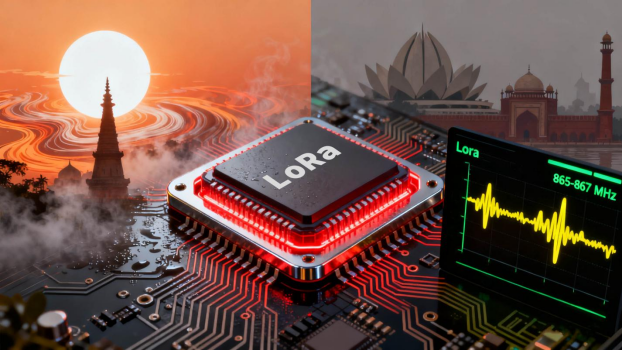
Frequency Compliance: How to Operate Legally in the Narrow 865-867 MHz Band?
The Indian government has designated the license-free ISM band from 865 MHz to 867 MHz for low-power wide-area network technologies like LoRa. Here's a key point: it only has a 2MHz bandwidth, which is much narrower than the 7MHz bandwidth commonly used in Europe. This means that many common "868 MHz" modules on the market are illegal to use in India if their default operating channels (e.g., 868.1 MHz) are not configured correctly.
So, what should we as developers do? The first step in selection is to confirm whether the module's software (firmware and SDK) allows us to easily and accurately configure the operating frequency. A good module not only has compliant hardware but also mature software tools that let us "lock" all operating channels within the legal 865-867 MHz range, preventing any accidental out-of-band transmissions.
The good news is that mainstream modules like the LoRa126X and LoRa126XF30 series can support this frequency band on a hardware level. The real challenge lies in whether we have utilized their software tools to ensure that every deployment is 100% compliant with local regulations.
Environmental Adaptability: Can Modules Work Stably in India's Heat and Humidity?
India's climate is a significant test for electronic devices, with extreme heat, high humidity, and ubiquitous dust. These factors can affect RF performance and even shorten a module's lifespan. Therefore, choosing a module that meets industrial-grade specifications (operating temperature -40°C to +85°C) is fundamental to ensuring project success.
Among all environmental factors, temperature change has the biggest impact on communication stability. You might not know that one of the most vulnerable components in a communication link is the crystal oscillator, whose frequency "drifts" with temperature. In a technology like LoRa, which has extremely high requirements for frequency accuracy, even a small drift can lead to signal loss.
How can this problem be solved? The answer is to choose a module with a Temperature Compensated Crystal Oscillator (TCXO). A TCXO can monitor the temperature in real-time and actively correct for frequency drift, acting like an insurance policy for your communications.
The following modules are equipped with a high-precision (0.5ppm) TCXO:
LoRa126X Series: Includes the LoRa1262-868 and LoRa1262-915, both of which come with a 0.5ppm TCXO as the default shipping option;
LoRa126XF30 Series: The LoRa1262F30 model also has a built-in 0.5ppm TCXO;
LoRa1121: While this module doesn't have a built-in TCXO, its pin definition includes a VTCXO pin that can be used to power an external TCXO, thus supporting temperature compensation through an external connection.
For applications with extremely high reliability requirements, such as smart meters and critical infrastructure monitoring, we strongly recommend choosing modules that are equipped with or support a TCXO. This small investment can ensure up to a decade of stable operation for the device, making it absolutely worthwhile.
To learn how to choose the right LoRa module based on specific application scenarios, you can return to our main guide, "A Guide to Selecting LoRa Modules and Suppliers for the Indian Market in 2025"
Contact Us
 +86-755-23080616
 sales@nicerf.com
Website: https://www.nicerf.com/
Address: 309-315, 3/F, Bldg A, Hongdu business building, Zone 43, Baoan Dist, Shenzhen, China
Related Products