In the rapid expansion of IoT devices, two capabilities are increasingly coming to the forefront: low-power communication and low-cost positioning. Engineers often find themselves having to choose between the two, but real-world demands are pushing for both simultaneously. The traditional “communication module + positioning module” architecture not only struggles with integration and miniaturization, but also exposes significant challenges in GPS signal blind zones such as indoor or underground environments. Additionally, growing pressure to control costs has made it critical for the industry to find ways to achieve both communication and positioning functions with low power consumption and at minimal cost.
In response, the industry is actively exploring innovative solutions that aim to naturally integrate communication and positioning into a single module. By simplifying system architecture, fine-tuning power consumption, and decoupling from cloud services, these solutions lighten system load and enhance overall efficiency. Against this backdrop, a clear trend is emerging toward integrated communication and positioning, full-spectrum support, and cloud platform synergy. In line with this trend, NiceRF has launched the LoRa1120 module based on Semtech’s LR1120 chip—an important attempt to bring this converged architecture into real-world engineering practice.
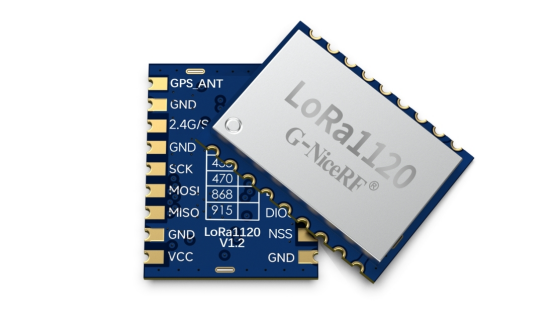
Built on a compact form factor, this module strikes a smart balance between communication, positioning, protocol support, and power efficiency—making it especially well-suited for cross-regional, distributed, and low-power terminal deployments. It integrates a cloud-native multi-constellation Global Navigation Satellite System (GNSS) scanner and a passive Wi-Fi MAC address scanner, both powered by Semtech’s LoRaCloud™ services, to enable low-cost, low-power global indoor and outdoor positioning.
For international users, positioning services can be accessed via Semtech’s LoRa Cloud. For users in China, the same functionality is supported through Tencent Cloud’s IoT development platform, effectively meeting the localization needs of different regions.
LoRa1120 Module Overview: A Compact Design Integrating Communication and Positioning
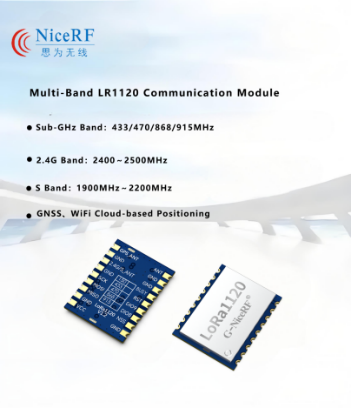
The LoRa1120 module builds on the core capabilities of the Semtech LR1120 chip, integrating the following features into a stamp-sized package:
Multi-band communication support: Sub-GHz (433/470/868/915 MHz, customizable from 150 to 960 MHz), 2.4 GHz (2400–2500 MHz), and S-band (1900–2200 MHz)
Low-power positioning: Integrated multi-constellation GNSS scanning + passive Wi-Fi MAC address scanning
Multi-protocol compatibility: Supports both LoRaWAN and Sigfox protocols, with LR-FHSS modulation capability
LoRa1120 Power Optimization Highlights
Powered by the Semtech LR1120 chip, the LoRa1120 module leverages cloud-based computing. The device itself is only responsible for signal acquisition, while millisecond-level positioning resolution is handled in the cloud via LoRa Cloud services. This offloading of computation significantly reduces local energy consumption, enabling highly efficient low-power operation.
Additionally, its Sub-GHz receive sensitivity reaches up to -144 dBm (BW = 62.5 kHz, SF = 12), allowing for stable data reception even in weak signal environments. This reduces the need for repeated retransmissions and minimizes unnecessary power drain.
Key power-performance specifications:
Receive current: <7 mA
Sleep current: <1 µA
Sub-GHz sensitivity: up to -144 dBm (BW = 62.5 kHz, SF = 12)
Configurable transmit power, up to 22 dBm
These features collectively address the core demands of today’s IoT endpoints: reliable connectivity, low-cost deployment, ultra-low-power consumption, and essential positioning awareness.
Where Can the LoRa1120 Module Be Applied?
1. Position Awareness for Small Workboats and Unmanned Vessels
In scenarios involving small workboats or unmanned surface vessels—such as port patrol boats, unmanned inspection boats, or buoy monitoring platforms—high-precision navigation like that provided by commercial marine radar is often unnecessary. These devices only need to periodically report their general location for backend scheduling or abnormal event alerts. Based on LoRa technology, the LoRa1120 module performs well in open environments like water surfaces, meeting communication needs within designated operational zones (e.g., ports or nearshore waters). Its GNSS + Wi-Fi hybrid positioning allows for approximate location data acquisition and cloud reporting.
2. Tracking and Dispatching of Non-powered Port Assets
For non-connected assets used in port operations—such as trailers or container movers—cost constraints and moderate accuracy needs make them ideal candidates for LoRa1120’s low-power, low-frequency positioning model. Wi-Fi scanning acts as a useful supplement to GNSS in infrastructure-dense areas within the port, ensuring continued location availability even indoors or in signal-obstructed zones.
3. Smart Tags for Unmanned Containers and Cargo
In cross-border logistics, asset tags must record location checkpoints and upload them to the cloud. The LoRa1120 supports both Sub-GHz and 2.4GHz dual-band communication, allowing seamless adaptation across regulatory frequency bands worldwide. This dual-band flexibility ensures reliable global tracking while maintaining tight control over power consumption.
Technology Choices Reflect a Shift in Deployment Logic
From a product designer’s perspective, the significance of the LoRa1120 goes beyond the hardware itself—it represents a strategic optimization of system logic:
Integration of communication and positioning reduces system coupling and enhances overall stability
Cloud-based positioning shifts part of the computational load away from the device, lowering hardware complexity and cost
Multi-band support increases global adaptability and helps reduce SKU diversity
More and more IoT professionals are moving away from the pursuit of all-encompassing feature sets and instead focusing on building systems that efficiently and effectively address the core needs of IoT endpoints. The true value of LoRa1120 lies in its ability to strike a precise balance—offering positioning, communication, and ultra-low power consumption in one compact solution. It delivers just the right set of features to enable cost-effective, power-efficient IoT deployments with essential positioning capabilities.
When Communication Meets Positioning: Exploring the Practical Value of Semtech LR1120’s Low-Cost Positioning Solution
In the evolving landscape of IoT, the boundaries between communication and positioning are becoming increasingly blurred. Applications that once required only basic connectivity now demand spatial awareness; likewise, many positioning tasks require timely, reliable data transmission. This convergence of needs is driving the development of solutions that can address both functions—simultaneously, efficiently, and affordably.
The Semtech LR1120 stands out in this context as a highly practical solution. By combining LoRa-based long-range communication with cloud-assisted GNSS and passive Wi-Fi positioning, the LR1120 delivers a compact and cost-effective answer to the dual demands of low-power communication and positioning. It enables devices to transmit data over long distances, while also periodically reporting location—even in challenging environments like urban canyons or semi-indoor spaces where GPS alone may falter.
This integration doesn’t just simplify system design. It also:
Reduces hardware complexity and BOM costs by eliminating the need for separate communication and positioning modules
Shifts computational load to the cloud, reducing energy consumption at the edge
Enables global deployment with its support for Sub-GHz, 2.4GHz, and S-band frequencies
Ultimately, LR1120 isn’t about cramming more features into a device—it’s about delivering the right features with precision and efficiency. In use cases such as smart asset tracking, distributed sensor networks, and mobile environmental monitoring, it offers a balanced, scalable approach that aligns with the real-world priorities of modern IoT deployments: low cost, low power, and just enough intelligence to get the job done right.
Related Reading:
1.New Product: LoRa1120 Multi-Band Communication Module – Low-Cost Indoor and Outdoor Global Positioning Module
2.Comprehensive Coverage: LoRa1120 Module Supports Satellite Communication and Multi-Band Transmission
3.LR1120 Communication Module Pre-release: LR1120 Uses Cloud-Based Calculation Technology to Break Through High Global Positioning Cost


 English
 +86-755-23080616
 sales@nicerf.com