

 English


How to solve the abnormality of the wireless module
Aiming at the abnormal problems of these wireless modules, NiceRF has compiled a solution for everyone, hoping to help the majority of users.
Jul . 2025
Communication modules operating in the 2.4GHz frequency band have become the preferred choice in fields such as industrial control, smart agriculture, wireless remote control, and sensor data collection due to their license-free use, global applicability, and strong anti-interference capabilities. However, when faced with a wide variety of 2.4G wireless transceiver modules on the market, users often raise the question: "Can different models communicate with each other?" The answer to this question is not as simple as a straightforward “yes” or “no.” Instead, it requires analysis from multiple technical perspectives, including underlying architecture, protocol compatibility, and modulation methods.
This article will start with communication principles and, with reference to NiceRF's range of 2.4GHz wireless modules—especially models such as RF2401F20, RF2401F27, and RF2401PRO—delve into whether different models can intercommunicate and how to achieve reliable and stable interoperability in practical applications.
The Core of 2.4G Wireless Module Intercommunication: More Than Just Frequency Matching
Many users mistakenly believe that "as long as the modules operate in the 2.4G band, they can communicate." This is inaccurate. While 2.4GHz defines the physical frequency range in which the modules operate, successful wireless communication also requires consistency or compatibility across several key technical aspects.
Essential Conditions for Proper Communication Between 2.4G Wireless Transceiver Modules
Same or Compatible Modulation Method
Modules must use the same modulation method, such as GFSK or LoRa. Modulation defines how data is encoded at the physical layer—modules using different modulation schemes cannot recognize each other’s signals.
Consistent or Compatible Communication Protocols
Communication protocols include frame structure, addressing mechanisms, synchronization, retransmission mechanisms, and more. Even if the modulation method is the same, mismatched protocol structures will prevent the devices from recognizing each other’s data packets.
Matching Communication Parameters
This includes operating frequency (channel), air data rate, and packet structure. All parameters must align to ensure proper transmission and reception.
Compatible Hardware Interfaces
If the modules are controlled by an MCU, the communication interface type and logic levels must be compatible. Common interfaces include TTL serial and SPI.
If there is any inconsistency in the aspects above, communication between modules will fail—even if they operate on the same channel.
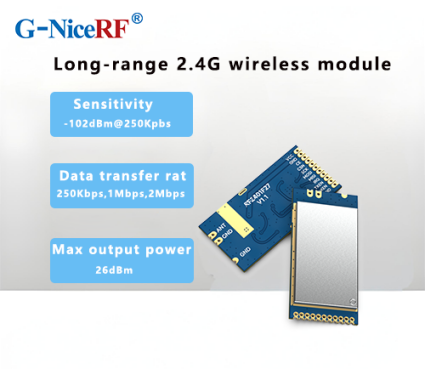
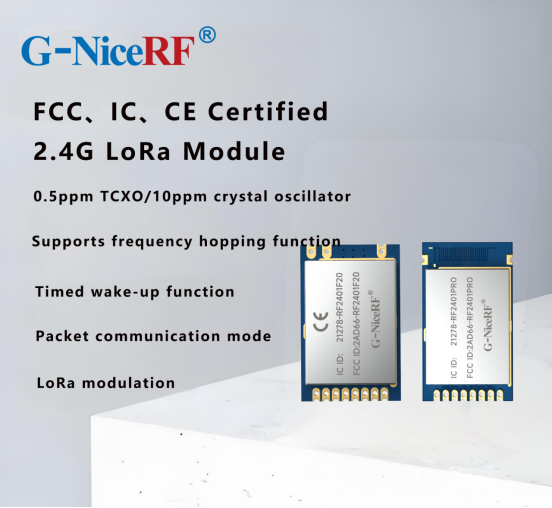
Within NiceRF’s 2.4G wireless module product line, there is a group of modules—though differing in model and power output—that can communicate with each other. This is because they are based on the same chip platform, nRF24L01+, use a unified modulation method (GFSK), and share the same communication protocol stack. With proper configuration, these modules can achieve mutual communication. This series of modules includes:
Module Models | Power | Product Features |
RF2401F20 | 20dBm | Standard output, cost-effective, suitable for medium-range communication |
RF2401F27 | 26dBm | High-power enhanced version, suitable for complex environments and long-range communication |
RF2401PRO | 0dBm | Supports transparent transmission, suitable for customized development |
These three modules support over-the-air data rates of 250kbps / 1Mbps / 2Mbps and offer communication features such as automatic acknowledgment, retransmission mechanisms, address matching, and CRC checking. By configuring unified communication parameters, they can easily achieve various communication modes including point-to-point, one-to-many, and many-to-one.
Typical Communication Case Studies: Smooth Communication Despite Different Module Models
RF2401F20 ↔ RF2401F27 (Point-to-Point Long-Distance Control)
In a smart farmland project, the control terminal uses the RF2401F20 to transmit commands, while the remote node adopts the high-power RF2401F27 for reception. By unifying the channel, data rate, and address settings, stable point-to-point communication is achieved, with transmission distances exceeding 1 kilometer in open environments.
Multiple RF2401PRO → RF2401F27 (One-to-Many Wireless Data Collection)
In an industrial data acquisition system, multiple sensor nodes equipped with RF2401PRO modules upload data periodically, and the central collector uses RF2401F27 to receive. Through address matching and polling mechanisms, stable many-to-one communication is maintained even in interference-prone environments.
RF2401PRO ↔ RF2401PRO (Transparent Serial Communication)
In portable devices, both ends integrate RF2401PRO modules. Data sent via serial ports achieves wireless bidirectional transmission with the effect similar to wired serial communication, making it ideal for data exchange between embedded devices.
Selection Suggestions and Advantage Analysis
For balanced communication stability and range, RF2401F20 is recommended.
For applications with obstacles or requiring longer transmission distances, RF2401F27 is preferred.
For local protocol processing, transparent serial communication, or multifunctional control, RF2401PRO is suitable.
Summary of Core Advantages
Consistent modulation methods and protocol architecture ensure communication stability.
High integration and low power consumption meet diverse application needs.
Support for automatic acknowledgment, retransmission, CRC, and other mechanisms enhances data reliability.
Expandable transparent transmission functionality reduces development complexity.
Whether different models can communicate ultimately depends on their compatibility in underlying communication protocols, modulation methods, and parameter consistency. NiceRF’s RF2401 series 2.4G modules based on the nRF24L01+ chip platform leverage unified communication logic and configurable parameters to easily achieve interoperability across models, enabling flexible applications in various wireless communication scenarios.
Related Reading:
1.How Can 2.4G Wireless Communication Break Through in Industrial Transmission and Control?
2.LoRa128X-C1 Series: High Sensitivity 2.4GHz, IPEX/PCB antenna, Long Range LoRa Modules
3.A Comparative Analysis of Common LoRa1280/RF2401PRO/RF2401 2.4GHz Wireless Modules
 +86-755-23080616
 sales@nicerf.com
Website: https://www.nicerf.com/
Address: 309-315, 3/F, Bldg A, Hongdu business building, Zone 43, Baoan Dist, Shenzhen, China


Privacy Policy
· Privacy Policy
There is currently no content available
Email:sales@nicerf.com
Tel:+86-755-23080616