

 English


Which wireless modules are used for drone control
As a key component of UAVs, wireless modules play a very important role. So, which wireless modules are used in drone control, and what is the future
Nov . 2025
A full-duplex system means no button-pressing and no frustrating delays. Old radios slow your team down significantly. This guide explains why a full duplex intercom system is much better, covering the core technology, its best applications, and clear comparisons. You truly need to understand all the advantages of this system.

A half-duplex system waits before it reacts, forcing you to wait for the button to reset before you can even press it to talk. You must understand that this slow process is not like real life; in fact, it is an archaic way of doing things. Only one person talks at a time, and this limitation directly leads to serious delays. A full duplex intercom system is completely unlike those old devices.
We can best describe this system as a phone call, where both parties can talk at the same time and both can listen. I remember working a live event where our old half-duplex radios caused a 5-second lag, nearly missing a critical lighting cue; switching to full-duplex felt like magic. The conversations flow naturally, and no one is ever unable to speak when they need to.
You can work at a much faster pace if you have a full duplex wireless intercom system. This upgrade will help your teams avoid excessive confusion and delays. This is the main reason why you need to get one for your operations.
We will now look within the technology of a full duplex intercom system, allowing you to discover the complex inner workings of the technology.
The Digital Signal Processing Engine, or DSP, is a primary component responsible for sharpening your vocal output. The DSP is also responsible for the complete elimination of disturbing background noise and voice echoes. Advanced Digital Signal Processors are utilized in G-NiceRF modules to guarantee clarity on the intercom wireless streams.
Acoustic Echo Cancellation, also called AEC, has a main purpose to neutralize audible feedback loops. AEC also serves to muffle the intercom’s microphone from the amplified output of its own speaker. This function, in terms of a wireless headset intercom system, is both necessary and beneficial. Having the microphone and speaker seamlessly remove that awful, dreadful squealing sound is the main goal. This important feature is commonplace in better wireless two way communication headsets.
Many professional systems operate on the 1.9GHz band, which people sometimes refer to as DECT. This specific band is least likely to be interfered with by WiFi operators, as they utilize the crowded 2.4GHz band. Using 1.9GHz is extremely beneficial for a full-duplex wireless intercom radio system. The choice results in far less lag and far fewer dropouts for your team.
A Mesh network is a system in which all users of the network become connected to each other. This setup is a much more advanced version of older, centralized systems. Each individual device has the capability of acting as a relay, which strengthens the full-duplex intercom system. This Mesh feature also improves the total range. The advantage of a Mesh network is that if one unit fails, the rest are still able to function and the network restores itself. This capability is extremely beneficial in larger spaces or complex buildings. A robust full duplex intercom circuit is the key to this reliable technology.
Sidetone is the sound of hearing oneself in the headset while speaking. Any excessive sidetone is undesirable and very distracting. Sidetone nulling accomplishes the goal of reducing this. It removes the local mic signal from your own earpiece. This process also suppresses feedback squeals. An effective wireless full duplex intercom system allows you to hear just the right amount of sidetone to speak normally.
Core Technology | AKA | Primary Function | Key Technical Action | Main User Benefit | Associated Tech |
DSP Engine | DSP | Sharpen vocal output | Eliminates background noise | Guarantees clarity | G-NiceRF modules |
AEC Cancellation | AEC | Neutralize feedback loops | Muffles mic from speaker | Stops awful squeal | Wireless headset |
1.9GHz Frequency | DECT | Avoid 2.4GHz WiFi | Operates on 1.9GHz band | Less lag; fewer dropouts | Radio system |
Mesh Network | Mesh | Connect all users | Devices act as relays | Improves range; self-healing | Full duplex circuit |
Sidetone Nulling | Sidetone Reduction | Reduce self-hearing | Removes local mic signal | Speak normally | Suppresses feedback |
Core Technology Comparison of a Full Duplex Intercom System!
Absolutely, a full duplex intercom system is better than half-duplex. Here are the five main points.
- Instant Responses: There are absolutely no delays. A two-way instant talk system is in place. This clear benefit allows teams to act very quickly. A 2 way intercom headset communication system changes how teams coordinate.
- Hands-Free 100%: You have no buttons to press, ever. You can simply go about your work. This hands-free operation is much safer in active environments.
- Uninterrupted Conversations: Your conversations are just like natural phone conversations. No party is ever cut off during the critical conversation. This is vital for a broadcast intercom system during live shows.
- Enhanced Bandwidth: These systems carry more data, which also provides much better audio quality. A professional production intercom system relies on this high-quality sound.
- Reduced Latency: The signals are sent instantly across the network. A full duplex wireless intercom headset has almost no lag. This lack of delay is crucial for a wireless backstage communication system.
Where is this technology used? A full duplex wireless intercom system is crucial in a wide variety of professions.
All film crews need clear and instant communication. Each film production unit operates with a dedicated security intercom system. Directors must communicate with their actors and camerapersons. They can provide input on the shoot's progress without interjecting. This is a significant time-saver. It also assists the lighting and sound operators in their coordination.
Safety is of paramount importance in the industry. For manufacturing workers, having hands-free communication is vital. A network-based wireless intercom system for buildings aids crews in communicating in high-risk areas. This is critical on construction sites. It directly helps in the prevention of incidents. Have you ever considered how many accidents could be prevented with instant hands-free warnings?
Event managers are very aware of these systems. They provide a link between separate teams distributed over a wide area. Stage construction teams communicate with the lighting and sound operators. This helps to avoid critical errors during live performances. A good communication system allows the event staff to communicate. It assists in seamless staff event coordination. As one event coordinator told us, "Using a full-duplex production intercom system cut our setup time by 30%; there was no more 'Wait, say again?'"
A coach is given the ability to provide instant feedback. Traditional communication means, like radios, are quite sluggish. Using intercom communication in basketball allows a coach to address the players. The players have the permission to both speak and listen. This is extremely beneficial during training. A full duplex intercom system for home can even be used for training purposes.
Each drone pilot needs to hear a spotter, and it is essential to hear them loud and clear. Having a headset that allows this communication is perfect. UAV headsets facilitate seamless audio transmissions. The audio arrives in real-time. There is no lag. This allows a pilot to fly safely. This is crucial in situations that are remote or dangerous.

What truly is the difference? Let's analyze half-duplex PTT and the “always-on” full-duplex intercom system.
PTT is short for “push to talk.” You have to push a button. Then you wait. There is a noticeable lag. This delay is detrimental to teamwork. A full duplex wired intercom system has no lag. There is no PTT button. Communication is instant.
There is a lag with turn-taking. You Speak, then I listen. PTT is “push to talk.” You have to wait for your turn. You must press a button. There are lags. This lag is detrimental to teamwork. Full-duplex intercom system models have no PTT lag. Communication is instant.
This slow and lagging process is completely unnatural. Half-duplex systems only enable one-way audio. You can talk. Then I can talk. Then it goes back to you. There is absolutely no concurrency.
With Full Duplex, you get an open mic that is “always on.” There are no buttons to press; you simply talk. This is great for work that requires your hands to be free. An open mic is a better 2 way wireless intercom system. It hears everything.
The best solution is complete two-way audio. You talk and listen at the same time. This is true conversing. This is offered by our advanced modules. They guarantee high audio quality, which goes way beyond old Walkie-Talkies.
Are you ready to get a system? There are five important things you should check first.
To start, you should count your team. How many people need to communicate? Some systems allow eight people at the same time. There are other systems that allow more. You must check the other systems. You may need to buy an expandable hub. This will change the full duplex intercom system price. You must think about your entire team.
You must check the range. How far do you need to go to talk? Many systems offer a 280m or 350m range. Some of our modules are capable of 1000m. I suggest you try out the range in your vicinity. Range is decreased or limited by walls and buildings. A quality wireless full duplex intercom system is able to offer a reliable range.
Your system should last throughout the whole day uncharged. You must check the battery life. Pro systems should last anywhere between 8-14 hours, with some reaching 20 hours. Also, check the charge time. Fast charging is preferable. You don’t want a fully dead wireless full duplex intercom system in the middle of a shoot!
Where are you going to be using it? You should check the IP rating. An IP65 rating is good. This rating means the unit is completely protected from dust, as well as water jets. This is vital for outdoor use, which is good for construction. A rugged 2 way wireless intercom system lasts much longer.
Is your chat private? You definitely need encryption. This stops people from eavesdropping. AES-256 is a very strong standard. This technology is crucial for security teams, but it is also helpful for corporate use. Always choose a broadcast intercom system with strong data encryption.
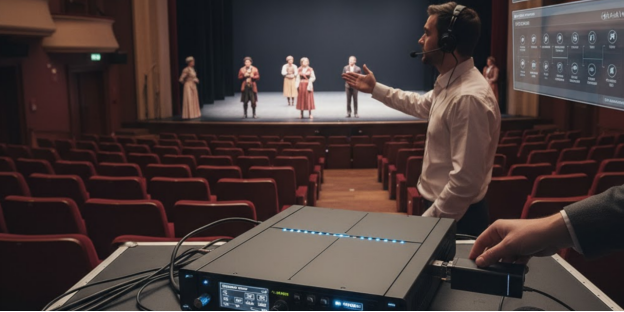
Which specs are relevant? You should look for these pro features in your full duplex intercom system.
The bandwidth for Pro Audio is a wide range. You should look for 20Hz to 7kHz. This range captures the full human voice. Cheaper systems often have a tinny sound. Good modules operate at 8K sampling. This gives you high audio quality. This is much better than old Walkie-Talkies.
Latency is another word for lag. You want it to be low. Latency under 50ms is ideal. This means the audio is almost instantaneous. A full duplex wireless intercom radio system must feel real-time. This is crucial for cues in theater. It is also important in sports coaching.
DECT technology is quite stable. It operates on a private band. This is usually 1.9GHz. It avoids the noise of WiFi and Bluetooth. This is an advantage for your 2 way wireless intercom system. You will have fewer drops. This is the reason why professionals trust DECT for its stability.
A Pro system should last a full shift. It is best to have a battery life of at least 8 hours. Many systems have 10 to 14 hours. This is very important. You cannot disrupt the workflow to charge. A reliable wireless headset intercom system should last the entire shift.
How many users can you add? A pro wireless intercom system uses an expandable hub. This base station lets you add users. You can grow your team. This is better than systems that have a fixed user limit. This gear is future-proof.
Spec | Technical Value | Description | Key Benefit | Comparison | Use Case |
Audio Bandwidth | 20Hz-7kHz | Wideband audio (8K sampling) | Captures full human voice | Vs. Tinny Walkie-Talkies | Pro Audio |
Latency | <50ms | Audio lag | Instantaneous audio | Real-time feel | Theater cues, Sports |
Stability | DECT (1.9GHz) | Private frequency band | Avoids 2.4GHz WiFi noise | Fewer drops | Professional reliance |
Battery Life | 8-14 Hours | Full shift operation | No work disruption | Vs. systems needing charge | Full-day shifts |
Scalability | Expandable Hub | Base station | Add more users | Vs. fixed user limits | Growing teams, Future-proof |
Pro Full Duplex Intercom System: Key Spec Comparison!
A full-duplex intercom system lets you talk and listen simultaneously, much like a phone conversation. Half-duplex systems are different. One party can speak at a time, and the other party has to remain mute.
It is used for natural conversations. A full duplex wireless intercom system is needed for teams that work in fast-moving environments. It is crucial for team safety. It enhances team effectiveness. It is much better for conversations.
Echo is removed by using a technology known as Acoustic Echo Cancellation (AEC). The AI DSP will clean the audio with a filter. A wireless full duplex intercom system will not have echo because the DSP ensures the mic will not pick up the speaker's output.
Yes, DECT systems operate around 1.9GHz. This is unlike WiFi, which uses the congested 2.4GHz range. The intercom system operates uninterrupted due to the bandwidth allotment. This improves the 2 way wireless intercom system range, lag, and dropout issues.
Walkie-talkies are traditionally half-duplex, as one must press a button to talk. Communication is obstructed because one cannot talk and listen simultaneously. The best full duplex intercom system models are more upgraded because they operate like phones, unlike Walkie-Talkies.
A full duplex intercom system makes communication hands-free, which avoids delays and ensures clear talk. Team productivity improves greatly when clear communication is achieved. Choosing the right system is vital, and G-NiceRF offers expert help. Find the perfect wireless intercom system that meets your exact needs on our website today.
 +86-755-23080616
 sales@nicerf.com
Website: https://www.nicerf.com/
Address: 309-315, 3/F, Bldg A, Hongdu business building, Zone 43, Baoan Dist, Shenzhen, China



Privacy Policy
· Privacy Policy
There is currently no content available
Email:sales@nicerf.com
Tel:+86-755-23080616