

 English
Which manufacturer of wireless transceiver module is better?
Some customers want to order wholesale wireless transceiver modules, but nowadays manufacturers are everywhere, and wireless transceiver modules on th
Jul . 2025
Sub-GHz wireless communication technology, with its advantages of low power consumption, strong penetration, and long transmission range, has become an ideal choice for a wide range of applications. From smart metering to remote monitoring, and from agricultural IoT to smart cities, Sub-GHz technology is quietly underpinning the communication foundation of the Internet of Everything.
What is Sub-GHz Wireless Communication?
Sub-GHz
refers to wireless communication frequency bands below 1 GHz, primarily
including 433 MHz, 470 MHz, 868 MHz, and 915 MHz. Compared to the 2.4
GHz band, Sub-GHz has longer wavelengths and lower attenuation, making
it more suitable for long-distance, low-bandwidth data transmission.
Common Sub-GHz communication protocols include: LoRa, Sigfox, and Sub-GHz Wi-Fi
Sub-GHz wireless communication also offers the following advantages:
In terms of power consumption, Sub-GHz can reduce transmission energy consumption due to the favorable propagation characteristics of lower frequencies.
In terms of transmission distance,
Sub-GHz supports communication over several kilometers or even tens of
kilometers, reducing infrastructure deployment costs and meeting the
networking needs of large-scale, wide-area IoT applications.
In terms of communication quality,
operating in lower frequency bands means Sub-GHz experiences less
interference, ensuring more stable and reliable communication.
Within the Sub-GHz wireless communication field, LoRa and FSK are two of the most widely used modulation technologies.
LoRa is
a long-range communication technology based on spread spectrum
modulation. It combines digital signal processing with forward error
correction coding, offering advantages such as long transmission
distance, low power consumption, strong anti-interference capability,
and high communication reliability—making it particularly suitable for
low-power wide-area network (LPWAN) applications in the IoT field.
FSK (Frequency
Shift Keying), on the other hand, is a modulation method that transmits
data by shifting the frequency of the carrier signal. It features high
data rates and strong anti-interference performance, making it more
suitable for short-distance, high-speed data transmission scenarios.
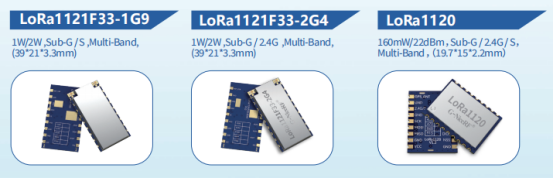
In the Sub-GHz wireless communication domain, NiceRF LoRa1120 and LoRa1121 modules are two standout products, both of which have achieved remarkable success and recognition in the field.
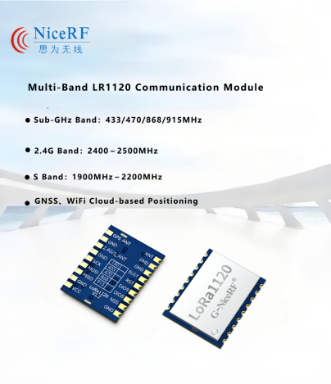
Key Features of the LoRa1120 Communication Module
Multi-band support for flexible communication:
The
LoRa1120 supports Sub-GHz bands (433/470/868/915 MHz), 2.4 GHz, and
S-band (1.9 GHz–2.2 GHz) for satellite communication, enabling greater
flexibility in wireless deployment.
Low-power positioning technology:
With
integrated GNSS and Wi-Fi scanning, the module can intelligently switch
positioning methods depending on the scenario. This allows for
continuous positioning while maintaining low power consumption—ideal for
battery-sensitive applications.
Hybrid multi-system positioning support:
The
LoRa1120 is compatible with both GPS and BeiDou systems. By leveraging
GNSS and Wi-Fi collaborative positioning, it enhances both accuracy and
acquisition speed, delivering higher stability for IoT devices in
complex environments.
Seamless terrestrial and satellite communication:
The
module supports seamless switching between ground-based and satellite
networks. Positioning calculations are performed through the LoRa Cloud
platform, enabling efficient, cloud-assisted location services.
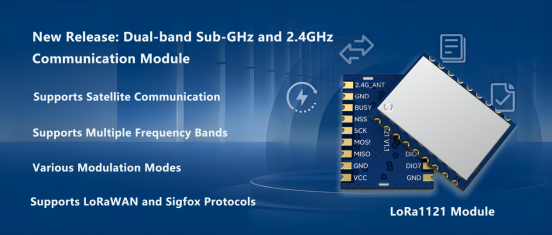
LoRa1121 Series Wireless Communication Module
The
LoRa1121 is an ultra-low-power long-range LoRa transceiver that
supports Sub-GHz, 2.4 GHz, and satellite S-band connections. It is
compatible with LoRa, (G)FSK, and LR-FHSS modulation schemes, and supports both LoRaWAN and Sigfox protocols.
With extremely high receiver sensitivity and configurable transmit power, the LoRa1121 achieves stable communication distances of over 5 kilometers in open environments. The module integrates ESD protection and encryption features, and adopts a compact stamp-hole package, making it easy to embed in various terminal devices. It is particularly well-suited for wireless applications that demand low power consumption and high reliability.
Conclusion
With
its unique frequency advantages and outstanding communication
performance, Sub-GHz wireless communication is becoming a solid
foundation for large-scale IoT deployments. From communication
principles and core modulation technologies to the real-world
performance of flagship modules, LoRa1120 and LoRa1121 exemplify the power of Sub-GHz technology in long-range, low-power applications, while also showcasing its broad potential in multi-scenario and hybrid network environments.
Related Reading
Comprehensive Coverage: LoRa1120 Module Supports Satellite Communication and Multi-Band Transmission
LoRa1121F33-1G9 Module: An Efficient and Flexible Long-Distance Wireless Communication Solution
 +86-755-23080616
 sales@nicerf.com
Website: https://www.nicerf.com/
Address: 309-315, 3/F, Bldg A, Hongdu business building, Zone 43, Baoan Dist, Shenzhen, China


Privacy Policy
· Privacy Policy
There is currently no content available
Email:sales@nicerf.com
Tel:+86-755-23080616