

 English


Application and advantages of LoRa wireless module
The transmission distance of the LoRa wireless module is farther than that of the traditional FSK and GFSK, and the ability to penetrate walls is also
Jul . 2025
UART wireless serial modules serve as a critical bridge connecting sensors, main control units, and remote servers. As application demands continue to grow, a single communication method is no longer sufficient to meet the needs of diverse scenarios. As a result, wireless serial modules are evolving toward more flexible, more reliable, and longer-range communication—especially with the integration of LoRa spread spectrum technology, which introduces a new transmission mechanism.
UART wireless serial modules are integrated hardware-software communication devices designed to provide simple wireless data transmission solutions, reduce development complexity, and shorten the R&D cycle.
General Transmission Modes Explanation
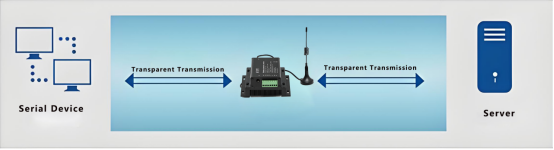
Transparent Transmission
Transparent transmission mode is the most commonly used basic mode. The module functions like a "wireless serial cable," directly transmitting serial data without the need for protocol parsing. It is simple to operate and responds quickly, making it suitable for point-to-point or point-to-multipoint communication.
Data is sent and received via transparent broadcasting—what is sent is exactly what is received.
Note: For RF modules within the same network to communicate properly, their frequency band, channel, RF data rate, and AES key must be configured identically. If any of these parameters differ, communication will fail. Additionally, the module's serial parameters must match those of the connected device; otherwise, communication will also be unsuccessful.
Fixed-point Transmission Mode
This mode allows data to be sent to a specific node by designating a target address, enabling independent communication among multiple terminals. It is suitable for scenarios that require selective transmission and control among multiple nodes.
Command Transmission Mode
In this mode, a specific frame format is used to parse command type, address, and parameters to enable remote configuration and control. It is suitable for point-to-point and master-slave batch management, and is commonly used in industrial automation scenarios.
With the continued advancement of wireless communication technologies, UART wireless serial modules based on LoRa spread spectrum have emerged. They offer long-distance, highly anti-interference, and low-speed but stable communication while maintaining low power consumption. More importantly, upgraded modules have greatly expanded communication modes, introducing multiple special modes tailored to different application scenarios:
Master-Slave Transmission Mode
A master node is designated within the network, and multiple slave nodes perform data transmission under the master’s coordination. This ensures orderly communication with minimal conflicts, making it particularly suitable for centralized collection and control systems such as smart agriculture and building security.
Scheduled Reporting Mode
Devices automatically report data to the central node at preset intervals without requiring intervention from a host controller. This mode excels in periodic tasks like environmental monitoring and meteorological data collection by reducing power consumption and improving communication efficiency.
Active Polling Mode
The central node (host) periodically sends requests to each terminal. Terminals respond with data only upon receiving the request. This mode helps prevent missed reports and ensures complete data reception from all nodes, making it ideal for applications like asset tracking and inspection systems.
MESH Networking Transmission Mode
In MESH mode, routing modules have automatic routing capabilities. Users can combine multiple modules to form a network with no blind spots and no distance limitations. This mode is especially suited for wide-area or complex terrain deployments, such as in mining areas, forests, and water conservancy projects.
Core Features and Parameter Overview of the Module
Operating Frequency: Selectable among 433 / 470 / 868 / 915 MHz
Output Power: 1W, 2W, 5W options
Serial Interface: TTL / RS232 / RS485
Data Rate: Configurable, supports 0.3 kbps to 62.5 kbps
Encryption: Supports AES 128-bit encryption
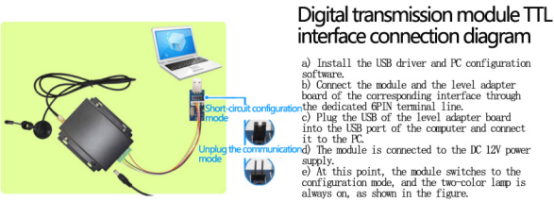
Configuration: Supports PC software-based command configuration
Hardware Protection: Equipped with hardware watchdog auto-reset circuit, over-current/over-voltage/reverse polarity protection, and electrostatic protection circuitry
Deep Integration from Module to Application Scenarios
With the growing adoption of LoRa spread spectrum modules, UART wireless serial modules are no longer just communication carriers—they’ve evolved into “neural nodes” within intelligent terminal systems. From centralized control in urban lighting to precision irrigation in smart agriculture, from remote diagnostics of industrial equipment to real-time alerts in security systems, the communication modes of these modules are increasingly integrated with diverse application scenarios.
In addition, the software of these modules is designed with multi-mode integration, allowing users to switch between various working modes via PC software configuration, enabling flexible adaptation to different deployment needs.
Related Reading:
How to Choose the Right LoRa Module? Five Key Factors to Master the Selection Essentials
LoRa Serial Communication Module Function Analysis: From Transparent Transmission to Mesh Networking
 +86-755-23080616
 sales@nicerf.com
Website: https://www.nicerf.com/
Address: 309-315, 3/F, Bldg A, Hongdu business building, Zone 43, Baoan Dist, Shenzhen, China


Privacy Policy
· Privacy Policy
There is currently no content available
Email:sales@nicerf.com
Tel:+86-755-23080616