

 English


How to choose 2.4 GHz transmitter and receiver module LoRa1280 & RF2401Pro
NiceRF: How to choose 2.4 GHz transmitter and receiver module LoRa1280 & RF2401Pro.
Dec . 2025
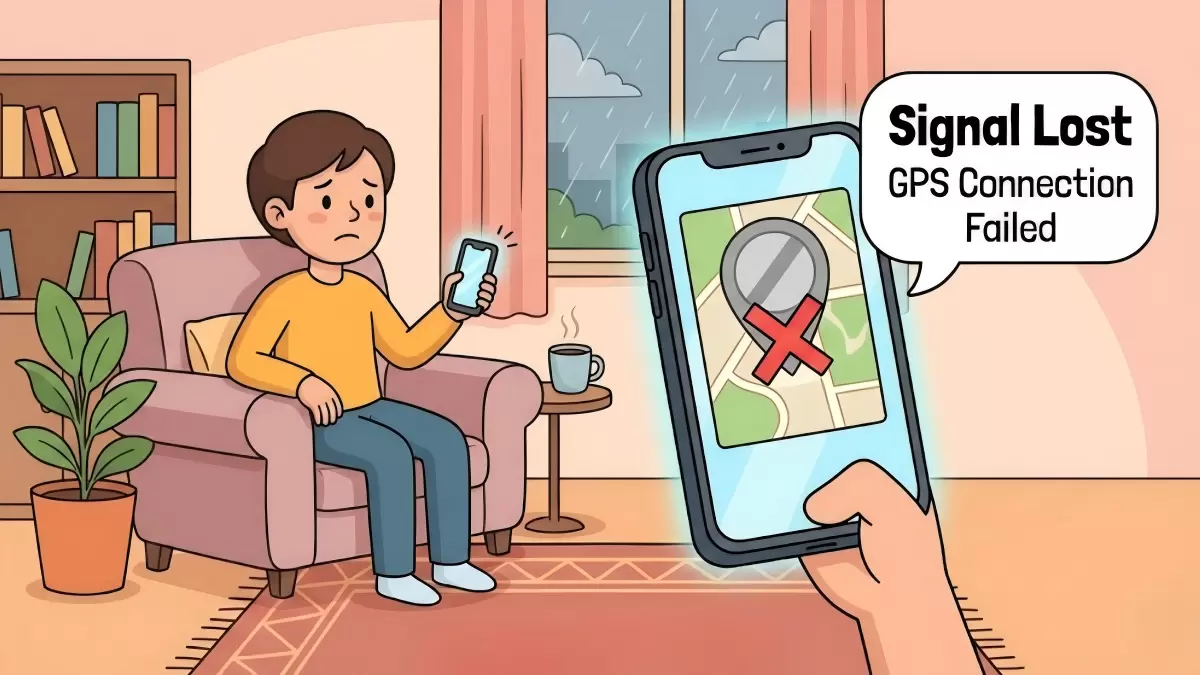
When you go inside, GPS signals hit a wall. They fade quickly, making normal positioning tools useless. For industries that depend on accuracy, this isn't just a problem; it lowers productivity and raises safety risks. Bluetooth 5.1+ and Wi-Fi 6 are good enough for general zoning, but they can't give you the centimeter-level accuracy that industrial automation needs. This is where Ultra-Wideband (UWB) technology comes in as a practical solution for industrial environments.
UWB modules enable Real-Time Location Systems (RTLS) to reach centimeter-level standards. UWB tracking gives you real precision that you can use to improve the efficiency of forklift routes in a warehouse or make sure that workers are safe in dangerous areas like mines. Let's look at the engineering behind these modules and see why they are so much better than other wireless technologies.
The UWB module is the core hardware for ranging and positioning. It works by sending ultra-short wireless pulses lasting only 1 nanosecond (the time it takes light to travel 30 centimeters), and the system calculates the time of flight of the signal to achieve centimeter-level ranging precision between devices.
In factory and warehouse positioning systems, it is installed in two types of devices: one is the UWB Tag worn by workers or attached to equipment, and the other is the UWB Anchor installed on room corners or walls. For example, G-NiceRF's UWB650Pro module is smaller than a bank card and contains all necessary hardware and basic software. This facilitates engineers to quickly build positioning systems, saving time on circuit development.
(UWB650Pro size 30.10mm × 20.00mm, Source: G-NiceRF Official UWB650Pro Datasheet v1.0)
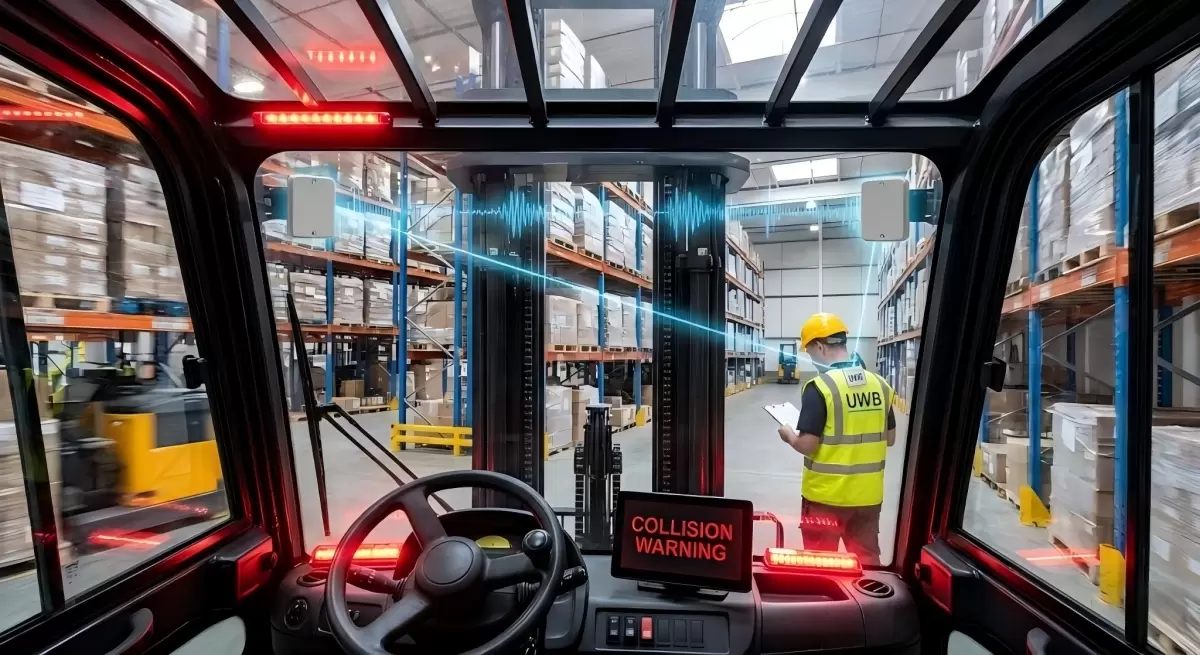
UWB modules achieve ranging functions by measuring the time of flight of radio signals.
The system keeps track of how long it takes for a signal to get from the UWB Tag to the UWB Anchor. Because radio waves travel at the speed of light, this time difference is the same as distance. UWB pulses are only 2 nanoseconds long, according to the IEEE 802.15.4z standard. This short time is very important because it lets the system stay accurate to the centimeter in messy industrial settings and helps it tell the difference between a direct signal and one that bounces off a wall (the multipath effect).
Time Difference of Arrival (TDoA) is a common way for UWB systems to track moving objects. It doesn't just take one measurement; it compares when the signal hits several Anchors to find the Tag's location. The IEEE 802.15.4z-2020 standard makes sure that devices from different companies work well together. It also meets the Industrial IoT's needs for security (like AES128 encryption) and low power use.
Your choice comes down to one question: do you need general awareness or precise tracking?
Feature | UWB Module (e.g., UWB650) | Bluetooth (BLE) | Wi-Fi |
Accuracy | ±10 cm (Pinpoint Precision) | 1-3 m | 5-15 m |
Range | >1 km (High-Power Models) | Short (<100 m) | Medium (<100 m) |
Interference | Resilient (Wide Spectrum) | Weak (Crowded 2.4GHz) | Weak (Crowded 2.4GHz) |
Latency | Ultra-Low (Real-Time) | Medium | Variable |
Best For | Industrial RTLS, Safety, Robotics | Retail, Consumer Tags | Internet Access, Data |
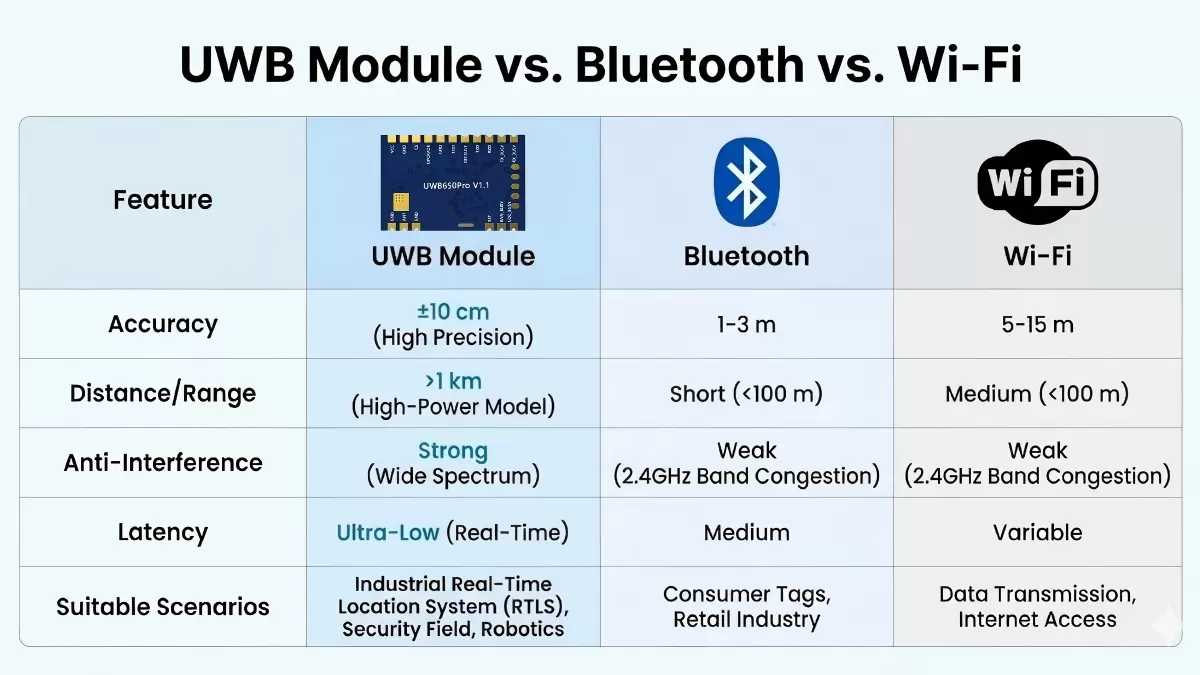
Consumer gadgets are good for finding your keys, but industrial UWB modules are built for reliability.
It's not always easy for standard wireless modules to stay connected over long distances. The Qorvo DW3000 chip, High Power Amplifiers (PA), and stable TCXO crystals are used in industrial units like the UWB650Pro and UWB3000F27. They push 27dBm of power in a straight line of sight, and the link stays strong over a distance of 1 kilometer. The UWB650Pro also works with MESH networking. This means that a module can work as a router and automatically find the best route for the network. This is a huge help in open-pit mines or huge logistics parks where you can't put Anchors everywhere.
Developing RF hardware is hard and needs a lot of knowledge. Industrial modules fix this by putting the UWB chip, RF transceiver, power management, and ESD protection all in one package. Some even come with the MCU. They use standard UART interfaces to talk to each other, which means that developers can start UWB ranging or send data with simple commands.
A worker's helmet tag needs to last a long time. It is very important to keep an eye on UWB power use. The UWB3000F00 and other specialized low-power modules use as little as 1μA when they are in deep sleep. That means that a regular CR2032 coin battery can power a personnel tracker for 6 to 12 months, which means that maintenance trips will be much less frequent.
Factories are noisy places for radio waves, especially in the 2.4GHz band. UWB avoids this issue by operating at 6.5GHz (Channel 5) or 8GHz (Channel 9) according to the IEEE 802.15.4z standard. In addition to using a cleaner frequency, modules like the UWB650Pro use mechanisms like ACK confirmation and Channel Clear Assessment (CCA) to ensure tracking data is transmitted reliably.
Knowing that a pallet is "in the warehouse" isn't enough. Managers need to know exactly what shelf and aisle it is on. UWB RTLS solutions give coordinates that are accurate to within 10 cm. This level of accuracy makes it possible to automate inventory management and stops forklifts from crashing into each other, which cuts down on human error by a lot.
Signals don't work well in underground mines. The long-range UWB650Pro lets you talk to people over 1 km, even in areas with complicated geology. You need fewer Anchors in this range, which lowers costs. The system keeps an eye on miners in real time, so if something goes wrong, rescue teams know exactly where to go.
UWB is used by hospitals to keep track of both patients and equipment. Tags that use very little power, like those on wheelchairs or wristbands (sleeping at <1μA), keep track of how long patients spend in triage or treatment. This information shows where there are problems, like a jam in the exam room, so administrators can quickly change the number of staff and equipment to shorten wait times.
G-NiceRF offers full support from integrating core UWB chips to terminal applications, including anti-interference antenna design, networking solutions that comply with the IEEE 802.15.4z standard, and industrial-grade OTA upgrade functions, helping customers build stable UWB tracking systems.
Standard modules usually work over a distance of 50 to 100 meters. But industrial versions with power amplifiers, like the UWB650Pro, can reach more than 1 kilometer in open spaces, making them great for big indoor or outdoor sites.
Not really. UWB frequency is high, so it doesn't go through things very well. It can go through wood or glass, but not through brick or concrete. Always put base stations up high so that you can see them clearly.
Prices are going down. When it comes to industrial setups, a modular approach—putting core modules into custom tags and anchors—is usually cheaper than buying consumer gear that is already made.
High-precision indoor positioning isn't just a "nice-to-have" anymore; for many industries, it's a requirement. UWB systems can work in both open fields and complicated factories because they can be accurate to within a centimeter and reach long distances. UWB is the best choice for important tasks like keeping mines safe and tracking assets when compared to older technology.
When deploying, you cannot just look at specs like battery life. Think about how stable the gear is in your environment, how well it deals with heat and dust, and how well it works with your current systems. It's always worth the time to do a field test to find problems early.
 +86-755-23080616
 sales@nicerf.com
Website: https://www.nicerf.com/
Address: 309-315, 3/F, Bldg A, Hongdu business building, Zone 43, Baoan Dist, Shenzhen, China


Privacy Policy
· Privacy Policy
There is currently no content available
Email:sales@nicerf.com
Tel:+86-755-23080616