With the rapid advancement of wireless communication, wireless serial modules have become widely used in fields such as industrial control, smart metering, environmental monitoring, and smart agriculture due to their ease of installation, stable communication, and cost-effectiveness. However, given the wide range of models and specifications available, how to accurately select the most suitable module based on specific needs has become a key concern for many engineers.
This article starts from the core technical parameters and combines practical application scenarios to explain the key points of wireless serial module selection, helping users make efficient and accurate choices.
Eight Key Parameters for Selecting Wireless Serial Modules
Communication Frequency
The communication frequency determines the signal's penetration ability, diffraction performance, and anti-interference capability. Common frequency bands include 170 MHz, 433 MHz, 490 MHz, 868 MHz, 915 MHz, and 2.4 GHz.
Low-frequency bands (e.g., 170 MHz, 433 MHz): Strong wall penetration and good diffraction performance, suitable for environments like buildings and underground areas.
High-frequency bands (e.g., 2.4 GHz): Suitable for applications requiring higher data rates over shorter distances, such as communication between IoT nodes.
RF Chip Solution
The communication performance of the wireless module largely depends on the RF chip used. Mainstream chips include:
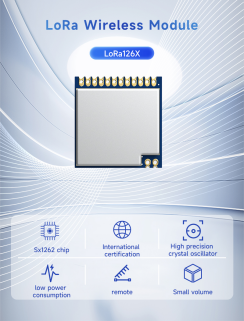
SX1278, SX1276, SX1280 (supporting LoRa communication)
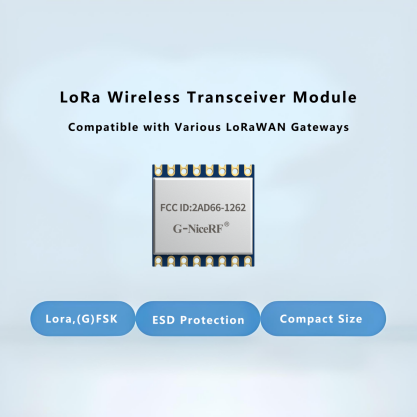
SI4438, SI4463 (supporting FSK/GFSK modulation)
CC1101 (low power consumption, high stability)
Communication Range
This is one of the most critical parameters. Since wireless communication is affected by environmental factors, it's important to choose a module that offers a communication range greater than the required one to ensure reliability.
Transmit Power and Receiver Sensitivity
Transmit Power: Indicates the strength of the module’s outgoing signal. Higher power extends communication range but increases power consumption.
Receiver Sensitivity: Represents the ability to receive weak signals. The lower the value (e.g., -126 dBm), the higher the sensitivity.
Operating Current and Power Consumption
Includes transmit current, receive current, and sleep current. Lower power consumption is critical for battery-powered applications.
Over-the-Air Data Rate (Air Rate)
Low air rates (e.g., 1.2 kbps): Enhance long-distance communication and anti-interference capability.
High air rates (e.g., 62.5 kbps): Suitable for short-distance, high-volume real-time data transmission.
Antenna Interface Type
SMA: Supports external high-gain antennas, offering stable signals and longer range.
IPEX: Suitable for compact spaces, convenient for internal antenna routing.
Onboard PCB Antenna: Small and easy to integrate, but has limited range.
Packaging Form and Size
Refers to the physical dimensions of the module. This should be considered based on the spatial constraints of the end product.

Recommended Selection Strategy: Wireless Metering as an Example
Gas meters, electricity meters, and water meters are among the most common applications of wireless metering systems. For such products, the following factors are especially important when selecting wireless serial modules:
Low data volume and low real-time requirements
Data transmission in wireless metering occurs infrequently with small data packets and minimal real-time needs. There's no need to choose modules with high air rates; in fact, reducing the air rate can improve both communication stability and range.
High requirements for penetration and diffraction
Wireless metering devices are often installed in complex environments such as residential buildings, basements, or corners. Modules must provide good wall penetration and diffraction. Modules operating at 433 MHz or 490 MHz are recommended, as these frequencies perform better in such environments.
Low power consumption is critical
Since most meters are battery-powered and expected to operate for long periods, modules must have ultra-low sleep current. Both transmit and receive currents should also be minimized to extend overall battery life.


 English


 +86-755-23080616
 sales@nicerf.com

