

 English


Contact us
HOME > ABOUT US > PRODUCT INFORMATION > WIRELESS CASCADE UPGRADE FOR THE K-1000C LED CONTR...
Wireless Cascade Upgrade for the K-1000C LED Control System
24
Apr . 2026
By NiceRF Team
Updated: Apr 24, 2026
Abstract
This paper provides a detailed description of a wireless upgrade solution for the K-1000C LED control system. The solution uses the LoRa611II wireless data transmission module to replace the traditional wired cascade method, aiming to solve problems such as complex wiring, high maintenance costs, and limited scalability in large LED lighting projects. The article presents a professional analysis from the perspectives of project background, system pain points, wireless upgrade architecture, technical advantages, and specific application scenarios, providing engineers in landscape lighting, architectural illumination, and stage lighting with a practical technical reference.
1. Project Background: Cabling Challenges in Traditional LED Control Systems
In architectural illumination, landscape lighting, stage lighting, and large outdoor lighting projects, LED lighting control systems commonly adopt a multi-level controller cascading structure. As a widely used asynchronous LED controller, the K-1000C reads preset effect files from an SD card and drives full-color LED fixtures to produce various animation and color-changing effects [1].
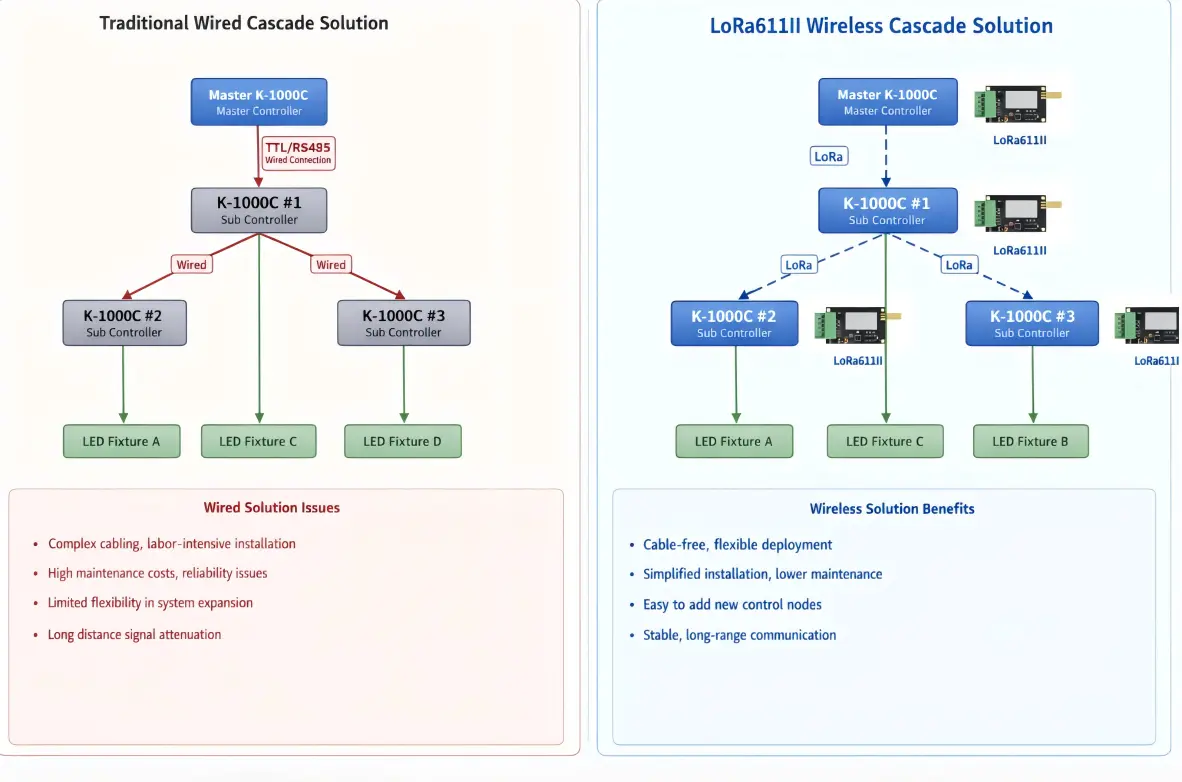
In traditional system design, multiple K-1000C controllers are usually connected in a wired cascade through TTL or RS series signals, forming a tree-shaped or chain-type control link from the master controller to each sub-controller. This approach performs stably in small- and medium-sized projects. However, as lighting systems become larger and deployment environments become increasingly complex, traditional wired cabling gradually reveals its inherent limitations in construction, maintenance, and later expansion.
1.1 Common Problems in System Deployment
- Complex wiring and installation: In large landscape lighting projects or irregular architectural lighting projects, controller installation points are scattered and physically far apart. Laying communication cables not only requires significant engineering work, but is also easily restricted by building structures, installation locations, and on-site environments such as crossing roads or rivers, which significantly increases construction difficulty and project duration.
- High maintenance costs: Outdoor environments are harsh. If problems occur in cables, connectors, or waterproofing treatment—for example, poor contact or oxidation caused by humidity, temperature differences, or vibration—communication stability will be directly affected. When faults occur, troubleshooting buried or elevated cables is time-consuming and labor-intensive, resulting in relatively high maintenance costs.
- Poor flexibility for system expansion: If additional lighting zones, control nodes, or layout changes are required in the later stages of a project, the traditional wired approach usually means communication lines must be re-planned and reinstalled, making modification difficult and inflexible.
- Risk of signal attenuation over long distances: Under long-distance cabling conditions, TTL or RS-485 signals may attenuate or be affected by external electromagnetic interference, increasing the risk of unstable data transmission and potentially causing delays or command loss in downstream lighting control.
To address these issues, replacing physical cables with mature wireless communication technology has become an effective technical approach for improving deployment flexibility.
2. Wireless Upgrade Solution: Integration of K-1000C and LoRa611II Modules
The core of this solution is to use LoRa611II wireless transparent transmission modules to replace the cascade cables between controllers and realize wireless transmission of control signals. While keeping the original control logic and SD card playback mechanism of the K-1000C unchanged, this solution only changes the physical transmission medium from wired to wireless.
2.1 Introduction to Core Components
- K-1000C LED Controller: As the core control unit of the system, it is responsible for parsing the lighting effect data stored on the SD card and generating control signals.
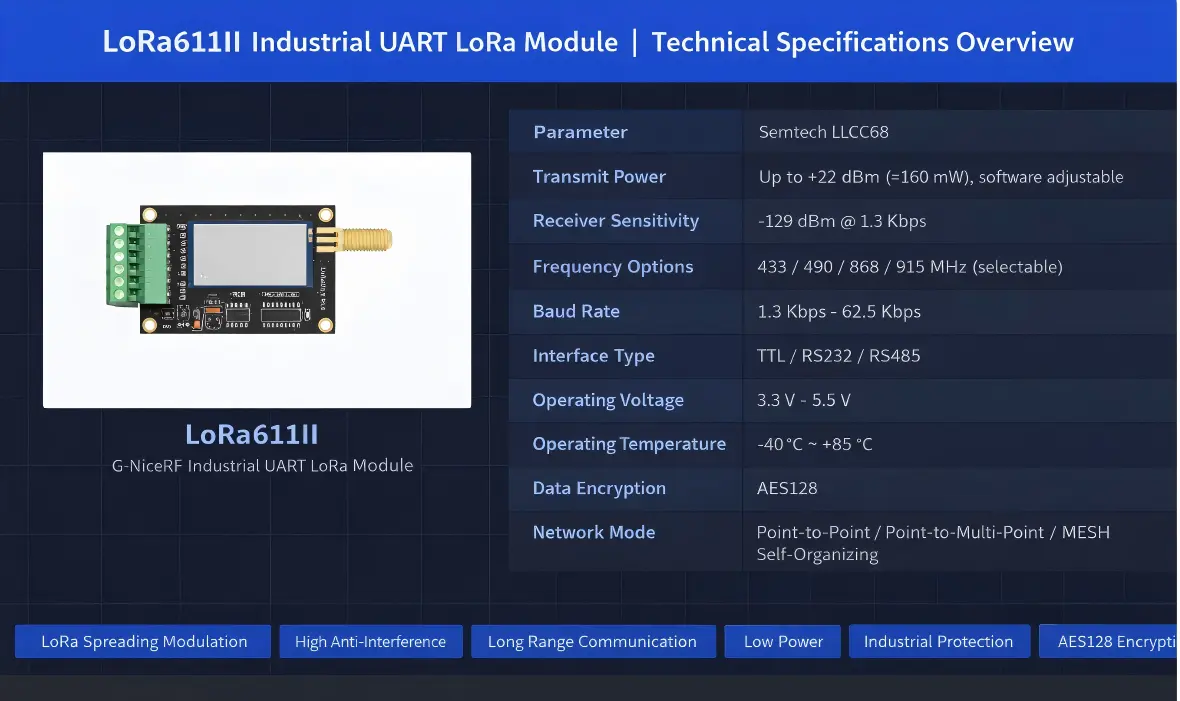
- LoRa611II Wireless Module: This is an industrial-grade UART transparent transmission module based on the Semtech LLCC68 chip. It adopts LoRa spread-spectrum modulation technology and provides wireless data transmission capability featuring low power consumption, long range, and high sensitivity. Its main technical parameters are shown in the table below:
| Technical Parameter | Value |
|---|---|
| Operating Frequency | 433 / 490 / 868 / 915 MHz (optional) |
| Transmit Power | Up to +22 dBm (approx. 160 mW), adjustable by software |
| Receiver Sensitivity | Up to -129 dBm @1.3 Kbps |
| Interface Type | TTL / RS232 / RS485 (depending on model) |
| Communication Rate | 1.3 Kbps - 62.5 Kbps |
| Operating Voltage | 3.3V - 5.5V |
| Features | Supports AES128 data encryption, LBT, MESH networking, etc. |
2.2 System Upgrade Architecture and Communication Process
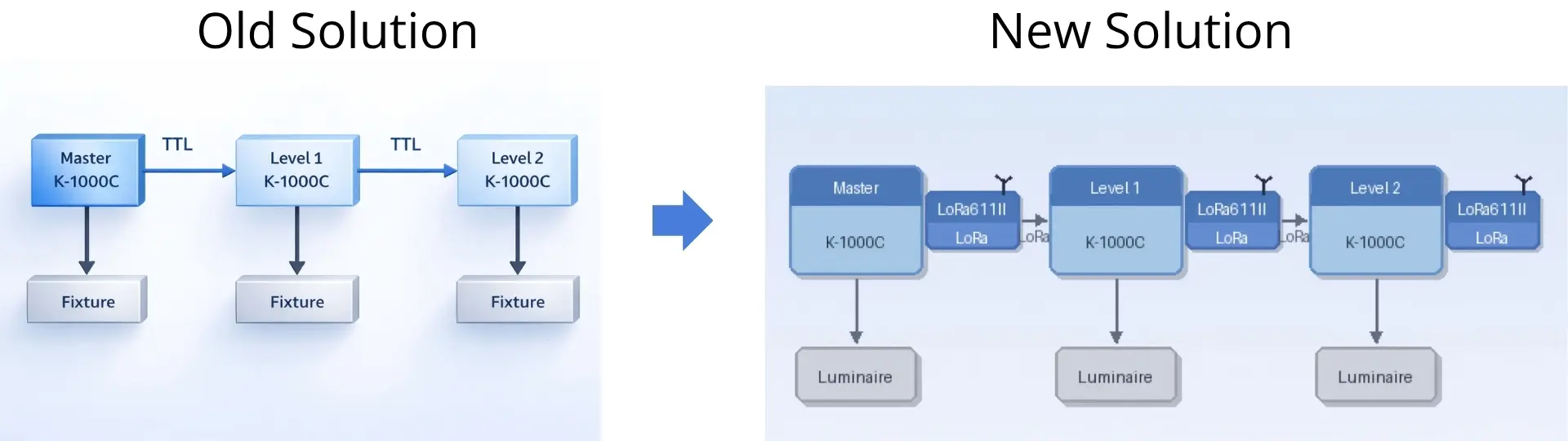
In the upgraded system, the signal output terminals (DAT, GND) of the K-1000C are connected to one LoRa611II module as the transmitting end, while another LoRa611II module as the receiving end is connected to the signal input terminal of the next-level controller or lighting fixture.
The communication process is as follows:
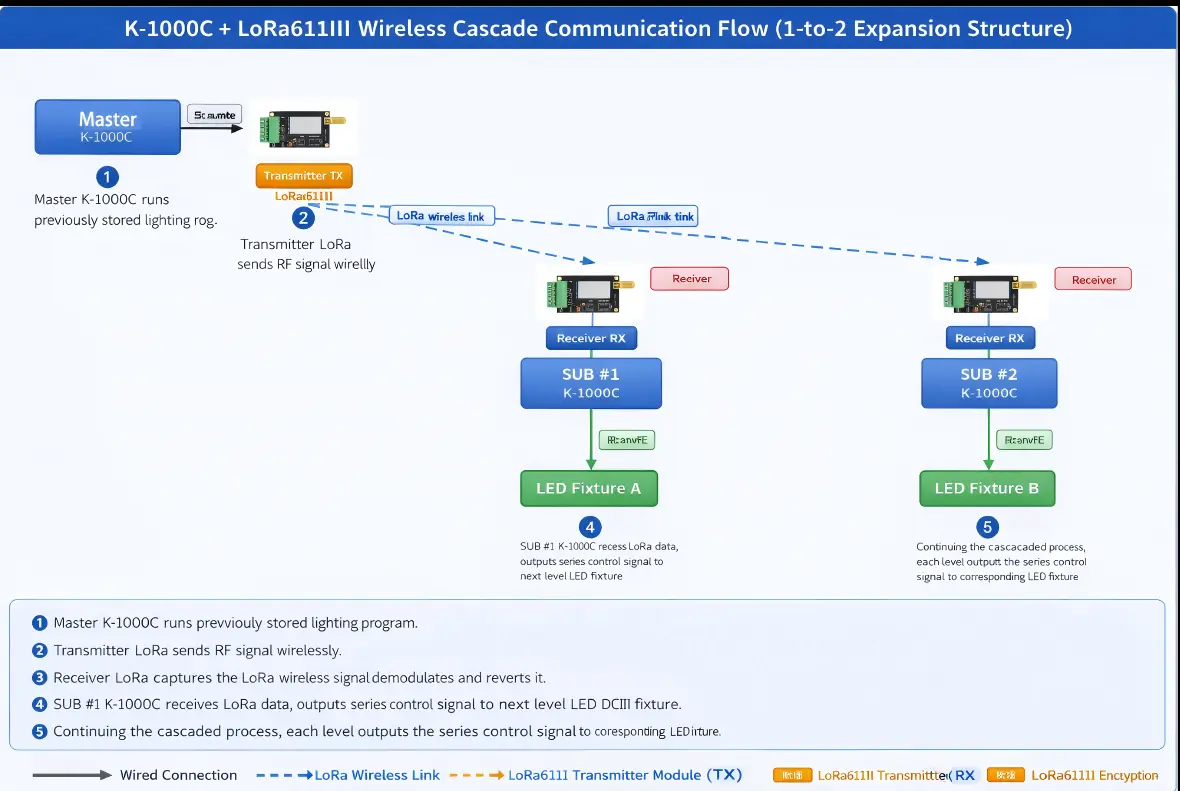
- Master control signal output: The master K-1000C controller outputs serial control signals from its DAT port according to the preset program.
- Wireless signal transmission: The LoRa611II transmitting module connected to the master controller modulates the received electrical signal into a LoRa RF signal and transmits it into the air through the antenna.
- Wireless signal reception: The remotely deployed LoRa611II receiving module captures the wireless signal and demodulates it back into the original serial electrical signal.
- Sub-control signal input: The receiving module outputs the restored signal through its DAT port to the next-level K-1000C controller or directly drives compatible lighting fixtures.
- Step-by-step wireless cascading: By configuring one or more pairs of LoRa modules for each controller level, a cascading control network based on wireless links can be established, supporting point-to-point, point-to-multipoint, or MESH network topologies.
Solution: LoRa611II is used to replace the original cascade cables and realize wireless communication between the controller and the next-level control nodes. While keeping the original control logic structure unchanged, the physical cascade connection is replaced by a wireless communication link.
3. Key Technical Challenges
In the process of upgrading the K-1000C LED control system from a traditional wired cascade to a wireless communication architecture, reliable operation cannot be achieved simply by adding wireless data transmission modules. Since LED lighting control systems have relatively high requirements for timing synchronization, delay control, and system compatibility, the following key issues need to be addressed in engineering practice.
3.1 Timing Synchronization and Delay Control
In a traditional wired cascade solution, control signals are transmitted directly through cables, and the delay is almost negligible. Wireless communication, however, must go through processes such as data encapsulation, over-the-air transmission, reception, and parsing, and each communication may introduce link delay ranging from milliseconds to tens of milliseconds.
If the original serial cascade structure continues to be used, in a multi-level controller scenario such as a three-level cascade, delay may accumulate level by level. The actual extent depends on wireless parameter configuration, packet length, and system topology, and this may cause asynchronous lighting animations in different zones, thus affecting the overall visual effect.
3.2 Control Interface Compatibility and Installation Complexity
The interface design of the K-1000C controller is mainly intended for traditional wired cascade solutions, while the LoRa611II module is a general-purpose wireless data transmission module. If directly connected, the interface form, signal connection method, and on-site wiring may all increase construction complexity, which is not conducive to rapid engineering deployment.
Through our supporting adapter board design, the LoRa611II wireless module can achieve stable and reliable connection with the K-1000C controller, while reducing installation complexity for customers and improving overall project delivery efficiency.
4. Technical Advantages of the Wireless Solution
- Improved deployment flexibility: Wireless connections eliminate dependence on physical cables, allowing more flexible placement of controller nodes, especially in completed sites or complex environments where cabling is difficult. Lighting fixtures can be deployed flexibly according to design requirements without being constrained by cable routing.
- Simplified installation and maintenance: It can reduce on-site work such as cable laying, conduit installation, and waterproof treatment of joints. During system maintenance, if a module fails, it can be replaced quickly without complicated line troubleshooting, shortening repair time. This is especially advantageous in high-altitude or confined-space operations.
- Convenient system expansion: Within wireless signal coverage, new control nodes only require additional LoRa modules and parameter configuration, without large-scale changes to the existing wiring. This provides high flexibility for future functional upgrades, such as adding lighting zones or control points.
- Reliable signal transmission quality: LoRa technology uses spread-spectrum modulation and offers strong anti-interference capability and high receiver sensitivity. With proper network planning and antenna deployment, it can provide stable and reliable communication links even in complex electromagnetic environments, improving the reliability and accuracy of control commands.
5. Application Scenarios
- Architectural landscape lighting: For projects such as large building facades and landmark buildings where lighting is widely distributed and cabling is difficult, the wireless solution can effectively reduce construction complexity.
- Urban nightscape and bridge lighting: In open spaces such as parks, squares, riversides, or bridges, wireless communication helps achieve more flexible and creative lighting layouts.
- Cultural tourism and performance lighting projects: In theme parks, tourist attractions, or large live shows, fixture layouts may need frequent adjustment. Wireless solutions can quickly adapt to changing scenarios.
- Outdoor advertising and signage systems: For scattered outdoor billboards or large display screens, adopting wireless communication can simplify system integration and reduce the installation and maintenance of communication lines.
6. Conclusion
Using LoRa611II wireless transparent transmission modules to upgrade the K-1000C LED control system into a wireless architecture is a mature and efficient technical upgrade path. This solution not only effectively solves the construction, maintenance, and expansion difficulties faced by traditional wired cascading in large and complex projects, but also provides greater freedom and flexibility for the design and implementation of modern LED lighting projects by leveraging the reliable long-range communication capability of LoRa technology. During the project planning stage, comprehensive evaluation and proper design of the wireless solution will lay a solid foundation for the long-term stable operation and convenient management of the system.
References
- Shenzhen Xinbo Laite Technology Co., Ltd. K-1000C User Manual. http://www.xinboled.com/html/05_k100ck.html
- G-NiceRF. LoRa611II: 160mW Industrial UART LoRa Module With ESD Protection. https://www.nicerf.com/uart-transceiver-module/llcc68-lora-module-lora611ii.html
Faq
Q: How stable is LoRa wireless communication? Will it be affected by weather?
A:
LoRa technology itself has strong anti-interference capability. In professional deployment, stable communication links can be established through proper channel planning, antenna selection, and installation. Weather conditions such as rain, snow, and fog may cause some attenuation to wireless signals, especially in higher frequency bands. However, in the commonly used 433/470 MHz LoRa bands, the impact is relatively small. By reserving sufficient signal margin during design, reliable operation can be ensured under most weather conditions.
Q: How many receivers can one transmitter control?
A:
LoRa supports point-to-multipoint communication. In theory, one transmitting end can be received by multiple receiving ends within the same network. The actual number of accessible nodes needs to be evaluated comprehensively based on over-the-air data rate, data update frequency, network topology, and site communication conditions. In the K-1000C application, one master controller can broadcast the same control signal to multiple slave controllers through one LoRa module, with each slave controller equipped with a receiving module, enabling synchronized control. All modules must be configured under the same channel and network ID.
Q: Is there latency in wireless transmission?
A:
All wireless communication has latency, including data packetization, over-the-air transmission, and unpacking. LoRa is a low- to medium-speed communication technology, and its link latency is usually related to packet size, air data rate, forwarding method, and network structure. In engineering applications, it generally ranges from milliseconds to hundreds of milliseconds. For LED landscape lighting scenarios, where some tolerance is allowed due to visual persistence effects, this level of delay usually does not produce a visually noticeable impact on the overall animation effect.
Q: How far can the LoRa611II module actually communicate?
A:
Communication distance is affected by multiple factors, including transmit power, antenna gain, antenna height, air data rate, and the actual environment. Under ideal line-of-sight conditions, transmission over several kilometers can be achieved with high-gain antennas. In urban or building-dense non-line-of-sight environments, the transmission distance will be shorter, but reliable coverage over several hundred meters can usually still be achieved, which is much greater than the distance limitation of wired cascading.
Contact Us
 +86-755-23080616
 sales@nicerf.com
Website: https://www.nicerf.com/
Address: 309-315, 3/F, Bldg A, Hongdu business building, Zone 43, Baoan Dist, Shenzhen, China
Related Products