

 English



Contact us
HOME > SOLUTIONS > SMART CITY > WIRELESS UPGRADE SOLUTION FOR K-1000C LED CONTROL ...
Wireless Upgrade Solution for K-1000C LED Control System
11
Mar . 2026
By NiceRF Team
Updated: Mar 13, 2026
— A Cascade Communication Replacement Solution Based on LoRa611II
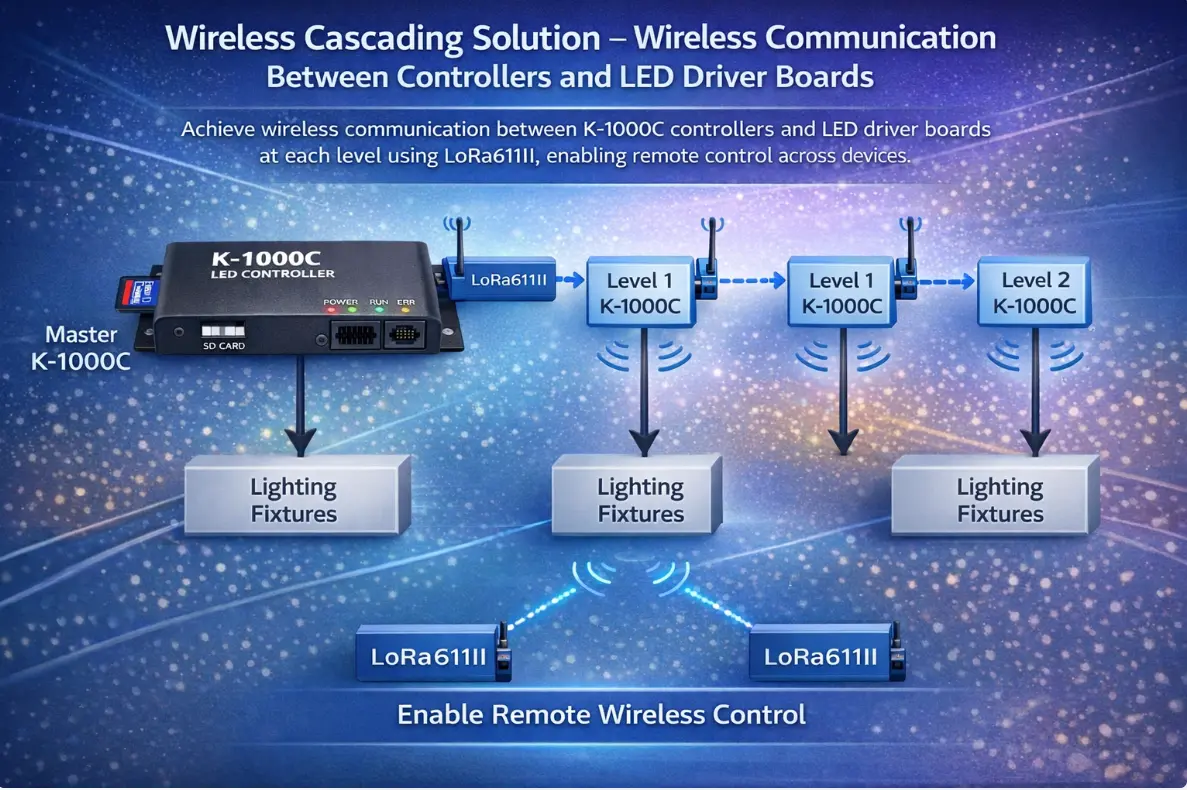
K-1000C is an LED asynchronous controller mainly used for offline control of full-color LED lighting systems. The device drives lighting fixtures by reading effect files stored on an SD card, enabling various animation and color-changing effects.
The controller supports 32–65,536 levels of grayscale control with Gamma correction, and is compatible with a wide range of LED driver ICs and control protocols. It can drive various types of lighting fixtures, including point, linear, and surface lighting sources, and supports cascading of multiple controllers.
In addition, the controller provides TTL and RS-485 (DMX) signal outputs, making it suitable for applications such as architectural lighting, landscape illumination, and stage lighting systems.
- Installation wiring is easily restricted by the on-site environment, resulting in larger construction workload and limited flexibility for system adjustment;
- During long-term operation, cable connectors may cause communication failures due to looseness or oxidation, increasing maintenance workload;
- When the system scale expands, rewiring is usually required, increasing the complexity of later modifications;
- In long-distance wiring conditions, signal attenuation may increase and may affect overall system stability.
To improve system deployment flexibility, the LoRa611II wireless transparent transmission module can be used to replace the original cascade cables, enabling wireless communication between the controller and the lighting driver boards. Under the premise of keeping the original control logic unchanged, the physical connection is converted from a wired link to a wireless communication link.
1. Solution
Use LoRa611II modules to replace the original cascade cables, enabling wireless communication between the controller and each stage of lighting driver boards. Without changing the original control logic structure, the physical cascade connection is replaced by a wireless communication link.
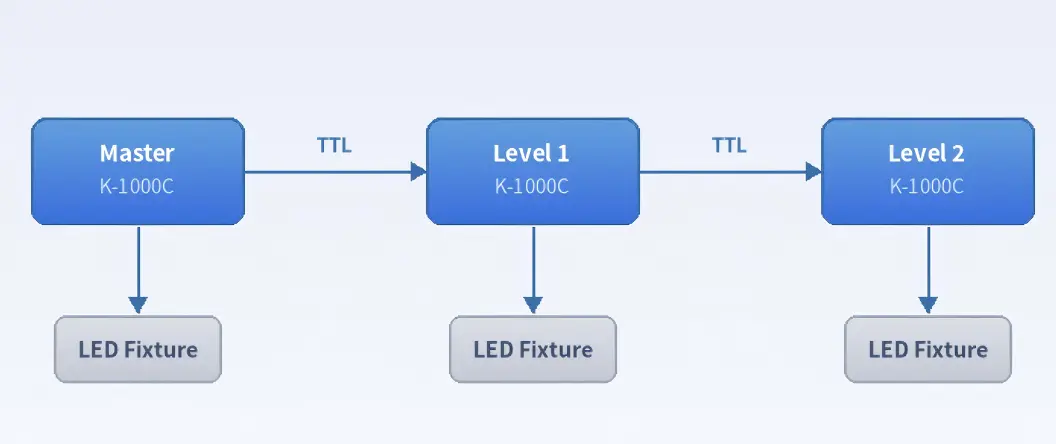
Old Solution
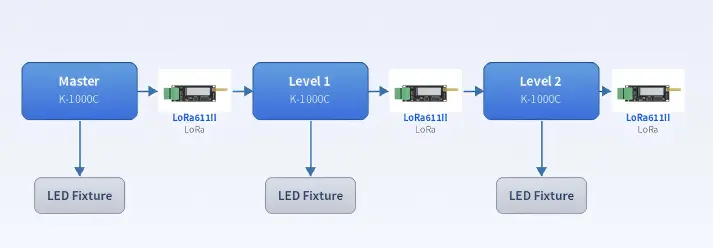
New Solution
2. Key Technical Challenges and Solutions
During the process of upgrading the K-1000C LED control system from a traditional wired cascade architecture to a wireless communication architecture, simply adding a wireless data transmission module is not sufficient to ensure reliable operation. Since LED lighting control systems have relatively high requirements for timing synchronization, latency control, and system compatibility, several key technical challenges must be addressed in practical engineering implementation.
2.1 Timing Synchronization and Latency Control
· Technical Challenge
In traditional wired cascade solutions, control signals are transmitted directly through cables, and the transmission delay is almost negligible. However, wireless communication requires several steps, including data encapsulation, over-the-air transmission, reception, and data parsing, which may introduce tens of milliseconds of latency in a single transmission.
If the original serial cascade structure continues to be used, the latency will accumulate level by level when multiple controllers are cascaded (for example, in a three-level cascade). This accumulated delay may cause lighting animations in different areas to become unsynchronized, thereby affecting the overall visual effect.
· Solution
To address this issue, the communication architecture of the system was optimized in this solution.
Topology Optimization
The traditional serial cascade structure is replaced with a Star Topology. The master controller sends control data simultaneously to all control nodes via wireless links, allowing the second-level and third-level controllers to receive the data at the same time. This approach eliminates the latency accumulation caused by multi-stage cascading.
Communication Rate Optimization
By optimizing the communication parameters of the LoRa611II module, the UART baud rate and wireless air data rate are properly configured to shorten the time required for each transmission. This helps reduce overall control latency and improves the consistency of lighting actions across multiple nodes.
Through these optimizations, the synchronization of lighting effects across multiple areas can be effectively improved in practical engineering applications.
2.2 Control Interface Compatibility and Installation Complexity
· Technical Challenge
The interface design of the K-1000C controller is primarily intended for traditional wired cascade systems, while the LoRa611II module is a general-purpose wireless data transmission module. If connected directly, differences in interface format, signal connections, and on-site wiring may increase installation complexity and make rapid deployment more difficult.
· Solution
To address this issue, a dedicated adapter board (Adapter Board) was developed in the project to provide standardized interface connections between the wireless module and the controller.
The adapter board performs the following functions:
- Provides electrical interface adaptation between the LoRa611II module and the K-1000C controller
- Simplifies on-site wiring and reduces the risk of manual wiring errors
- Offers a standardized interface structure to improve system integration efficiency
With the help of this adapter board, the LoRa611II wireless module can establish a stable and reliable connection with the K-1000C controller, while also reducing installation complexity for users and improving overall project delivery efficiency.
3. Key Advantages
3.1 Deployment Flexibility: After adopting a star topology, the main controller and each node no longer require physical connections. The signal can follow the lighting layout rather than forcing the lighting layout to follow the cable routing.
3.2 Maintenance Cost: When replacing lighting fixtures or modules, there is no need to reconnect wiring or reapply waterproof sealing tape. Modules can be replaced and immediately brought online, significantly reducing maintenance time, especially for high-altitude or confined-space operations.
3.3 Scalability: Within the wireless coverage area, new nodes can be added without additional wiring. Simply add a slave module and configure its parameters to integrate it into the existing system, providing flexible expansion for future upgrades such as adding new lighting zones.
3.4 Signal Quality: LoRa wireless communication provides strong anti-interference capability. Under proper deployment conditions, it can establish a stable communication link and maintain reliable transmission of control commands.
4. Technical Summary
Through systematic optimization of key aspects such as communication topology design, transmission rate tuning, and interface adaptation, this solution enables the wireless upgrade of the K-1000C LED control system.
While maintaining the original lighting control logic, the solution improves system deployment flexibility and engineering implementation efficiency, providing a more adaptable architecture for LED lighting control applications.
Contact Us
 +86-755-23080616
 sales@nicerf.com
Website: https://www.nicerf.com/
Address: 309-315, 3/F, Bldg A, Hongdu business building, Zone 43, Baoan Dist, Shenzhen, China
Related Products