

 English


Wireless Module: Communication Function Test
NiceRF: How to test whether the wireless module communication function is normal.
Nov . 2025
UWB Tracker technology gives you real-time tracking of your valuable assets where standard GPS often fails. Is precise, reliable data to keep your assets safe a major issue? We built a solid solution for your factory to give you real control. With better speed, you will move work along, so trust our proven systems.
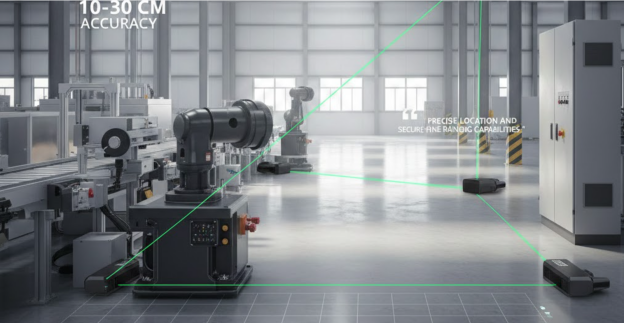
You definitely have valuable equipment or essential devices to keep track of, and in some specific instances, your devices may even hold critical data. You have probably established systems, but even the best systems require accuracies and trackable devices to perform best. By utilizing a UWB tracker, you can easily achieve the lowest accuracies of roughly 10 to 30 centimeters.
With the G-NiceRF UWB tracker, we guarantee trackable, reliable data for your operations. For your assets, we have designed the UWB tracker to allow you peace of mind in a tracked location and to give you the freedom to construct your tasks. Legacy signals will not counteract the UWB tracker, and integrating it with your safety devices gives you a robust set of safety signals.
A strong network consists of three components: a tag attached to a moving object, a base station attached to an object that does not move, and an engine that computes the location. The G-NiceRF UWB650 is your best option for mobile tags, as enabling UWB asset trackin is invaluable for sophisticated logistics. One tag communicates to three triangulating stations, so you receive location data in real-time.
The device that gives you excellent hardware performance is the Qorvo DW3000, and the network layer transmits values. In addition to this, UART port connections allow peripherals to join, which allows immediate scaling, specifically to a UWB tracker tag.
To maintain UWB tracking system performance, the user is required to follow the installation rules because poor hardware installation has a negative impact on system performance. This impact will change the placement of the base station, so follow these rules closely.
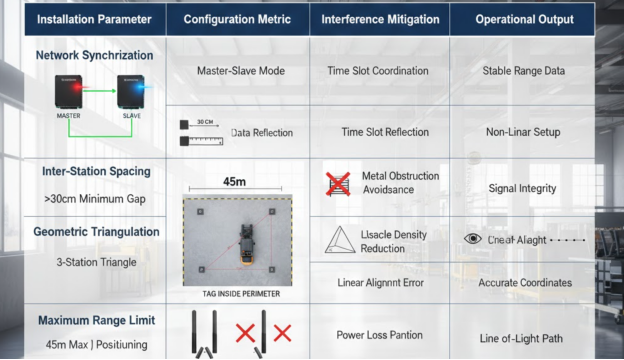
The first thing you must do is designate roles where one base station is the master and the remaining base stations will be slaves. This is the most optimal setup to avoid data collision, and in the absence of data collision, the master will coordinate all UWB indoor tracking data. Communication between base stations is orderly, and the G-NiceRF UWB650 handles this logic, resulting in stable range data.
You need to steer clear of anything metal, so you must install stations at least 30cm apart because walls reflect signals and metal obstructs RF waves. You have made a clear zone, which keeps the antenna secure, and this gap is important because it minimizes signal detuning. Your UWB tracker needs room to breathe because close quarters bring about signal integrity errors.
You set up a triangle by employing three base stations because this specific shape is important as it supports mathematical triangulation. Place them so the tag is kept inside, which is the best way to execute UWB location tracking. Do not position them in a line because linear lines lead to errors, and we confirmed this shape prevents errors. This configuration guarantees reliable coverage so you get accurate points.
You distribute them evenly and keep stations 45m apart because this is the most you can do distance-wise. This works in open spaces, but obstacles cut down the distance, so you must keep the environment in mind. We confirmed this distance because it guarantees robust connections so your UWB tracker stays linked. Going over this distance is risky because it limits the link budget.
You line up the antennas and have the panels face each other because polarization is important here. Loss of power occurs when angles are mismatched, so you keep them in a vertical position. This is how you get the best signal, and we built the antenna for this purpose because it needs line-of-sight. You do not want a blind spot here, and optimal signal is achieved by proper alignment, which increases reception.
Installation Parameter | Configuration Metric | Signal Physics Factor | Interference Mitigation | Topology Constraint | Operational Output |
Network Synchronization | Master-Slave Mode | Data Collision Logic | Time Slot Coordination | Non-Linear Setup | Stable Range Data |
Inter-Station Spacing | >30cm Minimum Gap | RF Wave Reflection | Metal Obstruction Avoidance | Clear Zone Radius | Signal Integrity |
Geometric Triangulation | 3-Station Triangle | Mathematical Triangulation | Linear Alignment Error | Tag Inside Perimeter | Accurate Coordinates |
Maximum Range Limit | 45m Max (Open Space) | Signal Attenuation | Obstacle Density Reduction | Line-of-Sight Path | Robust Connection |
Antenna Orientation | Vertical Positioning | Polarization Mismatch | Power Loss Prevention | Face-to-Face Panels | Optimal Reception |
Hardware Integration | G-NiceRF UWB650 | RF Wave Physics | Signal Detuning Control | Installation Rules | Precision Tracking |
UWB Tracker Installation & Configuration Protocols!
Choosing the correct methods depends on time and angles, so we clarify the engineering details.
You implement two-way ranging from the device where this device transmits a pulse. The station replies instantaneously, and we measure the round trip, which creates high accuracy. It is most suitable for a UWB wallet tracker because you gain precise distances. Strict synchronization is not needed, and while this mode is more power-consuming, you receive more robust data, and we support this mode fully.
You measure the time difference because signals reach the station in a varying way. The difference in time is used to calculate a position, which is TDoA, and this is most suitable for a UWB card tracker. The tag battery is saved because the tag only transmits and does not receive. This is the most recommended for scale because TDoA is great at handling a high number of users, however, you do need to have synchronized clocks.
You rely on the speed of the signal because you know it travels at the speed of light. We measure this flight in time, obviously, because it is important to have a high degree of precision. This should get you the distance instantly, and the DW3000 chip is fast, therefore you can trust the physics.
In this example, we use planes and get coordinates within the areas created by the three stations on the perimeter of the triangulated position. Then we calculate their X and Y coordinates, and for greater accuracy, we enhance the location tabs to work with precision finding android applications. For that, we need a set of coordinates that we use for trilateration, and then we get a specific location and subtract the path, which works great on 2D floor plans.
For greater accuracy, we want the stations aligned, so the anchors need to be synchronized on the same plane at the same time. For that, we set one master clock because this UWB tracking system is highly time-sensitive, and we are talking about millisecond accuracy.
Then the UWB anchors are synchronized to intervals, and we designed this system with an estimated nanosecond accuracy to avoid drift timing errors and get valid location data from the system. Have you ever considered how much productivity is lost when a single forklift goes missing in a 50,000-square-foot warehouse?
UWB is WiFi’s main competitor on this front, and UWB also handles signal reflections which are common in factory environments. There is no denying UWB dominates this aspect along with many others.
This is especially relevant given the high occurrence of dead zones, and also, WiFi is standard, but when signals bounce off metal, their paths become dead to WiFi. Ultra-wideband technology utilizes wide bandwidths to resist this along with its short pulse technology which sends signals as many times as necessary. An echo arriving later is classified digitally as a bounce signal, which establishes WiFi within the gap of a short pulse. We distinguish the echo from UWB, which allows you to maintain a stable connection, whereas WiFi is designed to filter the noise, leaving you with a highly stable link.
When dealing with WiFi, it is as if you are dealing with a narrow pipeline where data can easily get clogged and bottlenecked because users are all wide-banded and fighting for a narrow channel. In contrast, there is over 500MHz bandwidth, and it is an extremely wide pipeline where we can channel and send our data without sustaining any bottleneck. You get increased throughput and reliability.
More factories mean you get more noise interference, so we lower our power density enough to where it just looks indistinguishable from surrounding noise. We can work with Bluetooth without any interference problems, and other systems are silenced so our UWB Bluetooth tracker can achieve its optimal performance. You get a clean network while we coexist.
We believe your energy should be over-dispersed as it increases its security and makes it a lot harder to be intercepted. To hide a signal from narrow-band systems, we will lose it, so we help a UWB Bluetooth tracker so android users can retain their communication privacy while we protect it. The system’s physics naturally work to your favor.
Some materials can really block signals, but it does not matter to us because we have a lower frequency than WiFi for signal connection. We have higher frequencies for consistent tracking, so you can track through crates, and with a UWB tracker, you can maintain contact without dropping connection. It is a common issue, but we solved it.
You need fast data updates because slow networks cause accidents, so we provide fast industrial communication.
§ 6.8 Mbps Rate: You transfer data quickly because we support 6.8 Mbps speeds. The best UWB tracker for android needs this.
§ 850 Kbps: You choose longer range because 850 Kbps extends your reach. Your UWB tracker saves power now.
§ 1000 Packets: You send frequent updates because we handle 1000 packets/second. A UWB android tracker updates instantly.
§ Gbps Potential: You plan for growth because UWB supports Gbps speeds. Your UWB tracker network is future-proof.
§ Millisecond Response: You need instant reactions because ranging takes 25 milliseconds. We ensure real-time safety alerts.
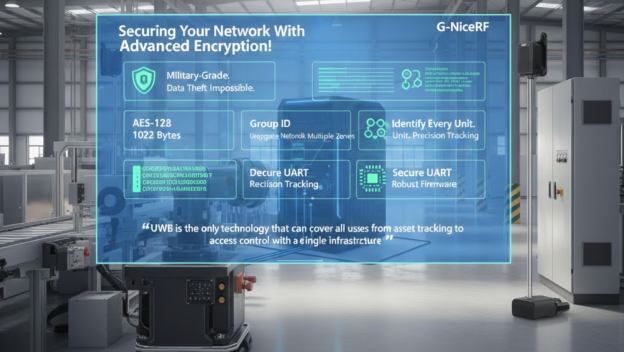
You must protect data because hackers target industrial networks, so we implement military-grade encryption standards.
You lock your data because we use AES-128 standards, which is military grade. Hackers cannot read it, so your UWB tracker stays safe and unauthorized access fails. We integrated this hardware, so it does not slow you, and you get speed and safety. Data theft is impossible; therefore, you trust this protocol.
You send large packets having Control Commands fitting well to UWB tracking data flows. You send enough data, more than supported (1023 bytes), even though encryption slightly reduces it. We optimized the payload which consists of vital info, and the capacity is sufficient as you manage complex tasks. We also add that the system remains robust.
You segregate the network by assigning a Group ID, making it so that only group members talk, preventing cross-talk. You manage multiple zones which a UWB tracker stays focused on, meaning it ignores outside tags. This simplifies network management as you organize your fleet, and it reduces channel noise which leads to logical separation.
You identify every unit, and every module is assigned an ID which allows you to know who is talking. This linkage enables one-to-one communication, and we make sure you track your tags very precisely. Your communication is broadcasted to ensure you have inventory control, and we give you complete control as we ensure every device has a unique ID.
You control the hardware because we use UART interfaces. You configure security settings, and the interface is reliable. External attacks fail here, so your UWB tracker obeys you. We built robust firmware, so you update via serial, and the system stays current. You maintain total control.
You have technical questions, and we have engineering answers, so here are common queries about our modules.
Yes, you get better range because channel 5 is 6489.6 MHz. It penetrates obstacles well, and we selected this band because it offers stability. Your UWB asset trackin improves because high frequencies fade faster. This band balances physics, and you get reliable indoor links because we tested this extensively.
You get high speeds because the serial port hits 115200 bps. This moves data fast, and you connect legacy devices. The integration is smooth, and we ensure no bottlenecks. Your host processor keeps up, and data offload is efficient. You maintain system speed because we prioritize data flow.
Yes, the capacity exists because three stations handle 30 tags. They talk simultaneously, and we optimized the timeslots. You scale the system, so UWB asset trackin becomes easy. You monitor a whole fleet, and the network manages traffic. You get seamless updates because we support multi-tag environments.
Yes, you control power because the UWB3000F27 is programmable. You tweak the range, and lower power saves battery. Higher power reaches 1.5km, so we give you flexibility. You match the site, so regulation compliance is easier. You optimize the link budget.
Yes, physics dictates that pulses on the order of nanoseconds cannot overlap. Echoes of late-arriving signals are ignored by the receiver, and we exploit this principle. What is UWB tracking if not accurate? Continuous waves, however, get confused, but G-NiceRF UWB eliminates this problem. Clean signals guarantee reliable data.
You now know the extent of precision because we provide accuracy down to the centimeter. Your factory requires accurate data to avoid crashing your operations at high speeds. Your network security must be impenetrable. For your success, install a G-NiceRF UWB tracker at your facility. We proudly support your development.
 +86-755-23080616
 sales@nicerf.com
Website: https://www.nicerf.com/
Address: 309-315, 3/F, Bldg A, Hongdu business building, Zone 43, Baoan Dist, Shenzhen, China


Privacy Policy
· Privacy Policy
There is currently no content available
Email:sales@nicerf.com
Tel:+86-755-23080616