

 English
What is the difference between SX1276 module and SX1278 module
SX1278 module and SX1276 module have advantages over FSK and GFSK in terms of transmission distance and anti-interference ability. Therefore, they are
Feb . 2026
As the number of IoT devices continues to grow, application scenarios place increasingly higher demands on low-power consumption and reliable wireless communication. Whether for large-scale IoT low-power data collection or mission-critical team voice communication, stable, long-range, and low-power wireless technologies remain the fundamental building blocks of system design.
This white paper provides an in-depth discussion of deployment strategies for two core wireless application scenarios in 2025 and beyond:
1.IoT systems based on LoRa modules and LoRaWAN,
2.Full-duplex intercom and Mesh networking solutions designed for professional applications.
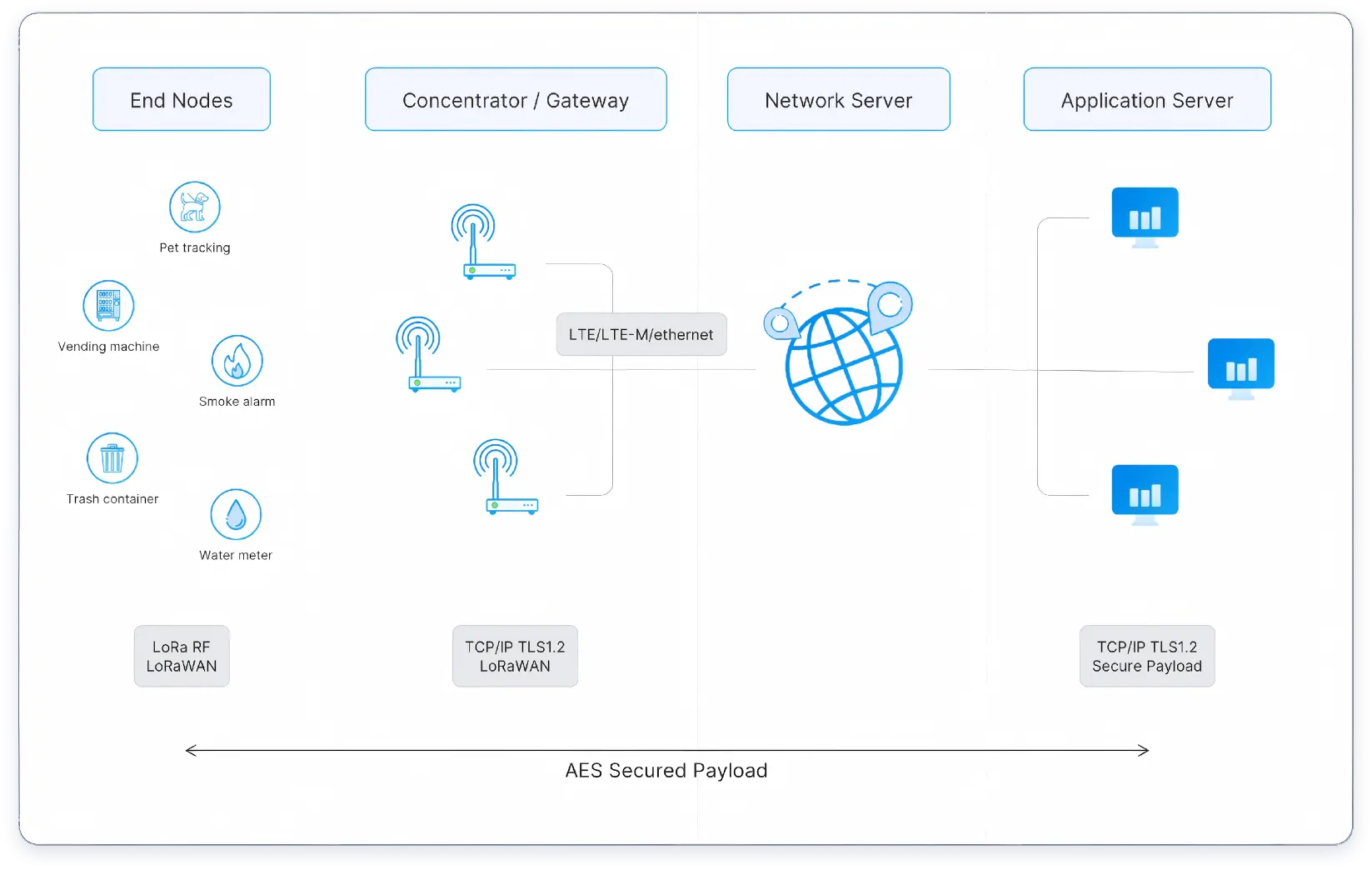
LoRa technology, with its long communication range and ultra-low power consumption, is a common choice for many low-power applications. A successful LoRa deployment fundamentally depends on proper network architecture selection and in-depth optimization of node power consumption.
Thanks to its long communication range and ultra-low power consumption, LoRa technology has become a common choice for many low-power IoT applications. A successful LoRa deployment depends primarily on proper network architecture selection and in-depth optimization of node power consumption.
At the early stage of a project, it is essential to select the appropriate networking approach—standardized LoRaWAN or flexible LoRa Mesh—based on the specific application scenario.
Suitable for scenarios where nodes are distributed over open areas and can be directly covered by one or more gateways.
Design considerations:
Gateway placement:
The gateway is the core of the network and should be installed at elevated locations to maximize coverage and minimize blind spots.
Capacity planning:
Evaluate gateway channel capacity based on the number of nodes, reporting frequency, and payload size to avoid network congestion.
Standardization advantages:
Leveraging the open LoRaWAN standard allows mixed use of end devices and gateways from different vendors, enabling large-scale, low-cost deployment.
Typical applications:
Smart cities (smart metering, smart parking), smart agriculture, and other large-scale standardized deployments.
Suitable for environments with complex terrain, severe signal obstruction, or long and irregular deployment areas.
Design considerations:
Relay node deployment:
Mesh networks rely on inter-node data relaying. Relay nodes (routers) with stable power supply should be deployed at key locations to form reliable transmission paths.
Self-healing and routing protocols:
Select Mesh protocols with intelligent routing algorithms. When a node or link fails, the network can automatically establish alternative paths to ensure reliable data delivery.
Power consumption trade-off:
Relay nodes consume more power than end nodes, requiring a balance between network connectivity and overall system power consumption.
Typical applications:
Forest fire prevention, mountainous environmental monitoring, tunnels, and underground mines.
| Feature | LoRaWAN (Star Topology) | LoRa Mesh (Mesh Topology) |
|---|---|---|
| Core logic | All nodes communicate directly with the gateway, which uploads data to the cloud | Nodes relay data between each other, forming multi-hop paths toward the gateway |
| Design focus | Gateway placement is critical; precise link budget calculation and site surveys are required | Relay node layout is critical; routers require careful planning and stable power |
| Power characteristics | Very low; end devices remain in deep sleep except during transmission, enabling multi-year battery life | Higher; relay nodes frequently transmit and receive data and are not suitable for pure battery operation |
| Suitable scenarios | Large-scale, wide-area, standardized deployments such as smart metering and environmental monitoring | Complex terrain with heavy signal obstruction such as forests, mountains, tunnels, and mines |
For battery-powered LoRa nodes, power consumption is the foundation of system viability.
Design focus:
Ensure the device enters microamp-level (μA) deep-sleep mode when inactive. Firmware should be carefully designed so that the device remains asleep for over 99% of the time, waking only briefly for data acquisition and transmission.
Design focus:
Wireless transmission is the primary power consumer and should be minimized.
Compact payloads: Transmit only essential data and eliminate redundancy.
Adaptive Data Rate (ADR):
A key LoRaWAN feature that allows the network server to dynamically adjust node transmit power and data rate based on link quality. Nodes closer to gateways use higher data rates with lower power, while distant nodes switch to lower data rates for reliability.
Design focus:
The fundamental power characteristics of the hardware module define the optimization ceiling. LoRa modules based on next-generation chipsets such as the Semtech SX126x series offer significantly reduced TX/RX current compared to previous generations, enabling substantially lower system power consumption.
Beyond data transmission, high-quality wireless audio communication is equally critical in many industries. Traditional walkie-talkies are bulky and functionally limited, while embedded intercom modules provide a more flexible solution. When combined with Mesh networking, full-duplex intercom systems significantly improve team collaboration.
Imagine a noisy construction site where team members can communicate freely, similar to a conference call, without pressing buttons or waiting. This is the key advantage of Mesh full-duplex intercom systems.
Automatic networking and dynamic routing:
Devices automatically discover nearby nodes and establish links after power-on. As users move, advanced Mesh algorithms dynamically update routing to maintain optimal connectivity, enabling seamless roaming and relaying.
Multi-hop relaying for extended range:
Each intercom device acts as both a terminal and a relay. Signals can hop through multiple nodes, bypass obstacles, and extend communication distance to several kilometers. For higher single-hop output power, modules such as SA618F30 with stable 1 W output can be selected.
Simultaneous multi-user communication:
Unlike traditional half-duplex systems, full-duplex allows multiple users (e.g., up to 8) to speak and listen simultaneously, enabling real-time, interruption-free communication.
High audio quality and noise suppression:
In extreme noise environments, clear voice communication is essential. Professional noise-reduction modules such as NR60 can suppress up to 60 dB of non-speech noise while preserving voice clarity.
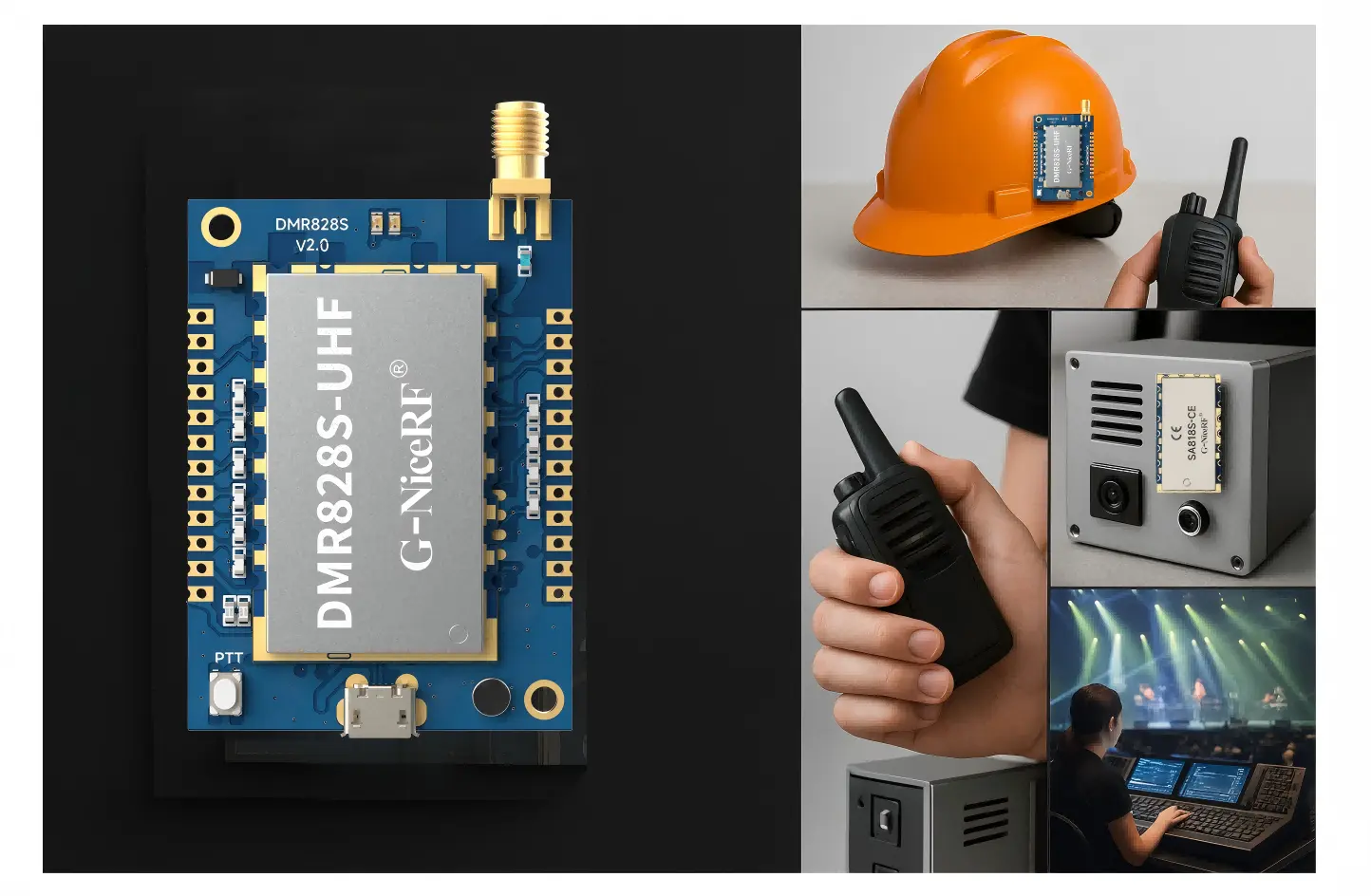
In many projects, new wireless capabilities must integrate with existing communication infrastructure. NiceRF provides mature embedded intercom solutions for this purpose.
Universal compatibility for analog systems:
SA818S is a professional embedded analog intercom module compatible with mainstream analog walkie-talkies operating on the same frequency and CTCSS/DCS settings. For higher output power, SA858 provides up to 5 W.
Seamless digital and analog integration:
DMR818S is a multi-standard digital intercom module with stable Mesh networking capability. Using the standard AMBE++ vocoder, it supports both analog communication and standard DMR systems, enabling smooth system upgrades. The 5 W DMR858 version is suitable for longer-range applications.
| Application Area | Product Model | Key Features | Keywords |
|---|---|---|---|
| Low-power data collection | LoRa1262 Series | Ultra-low power, high sensitivity | LoRa module, Industrial IoT |
| Mesh data / voice | SA618F30 | 1 W output, Mesh networking | Mesh networking, wireless audio |
| Analog intercom | SA818S | Compatible with all analog walkie-talkies | Embedded intercom module |
| Digital / analog dual-mode | DMR818S | AMBE++, DMR / analog compatibility | DMR intercom module, AMBE++ |
Large coverage area: Farmlands, orchards, and pastures span vast areas where wired deployment is impractical.
Massive number of nodes: Monitoring soil, light, CO₂, crop growth, and livestock health requires numerous sensors.
Power constraints: Most sensors lack mains power and must rely on long-term battery operation.
Cost sensitivity: Agricultural projects have long ROI cycles and require low deployment and maintenance costs.
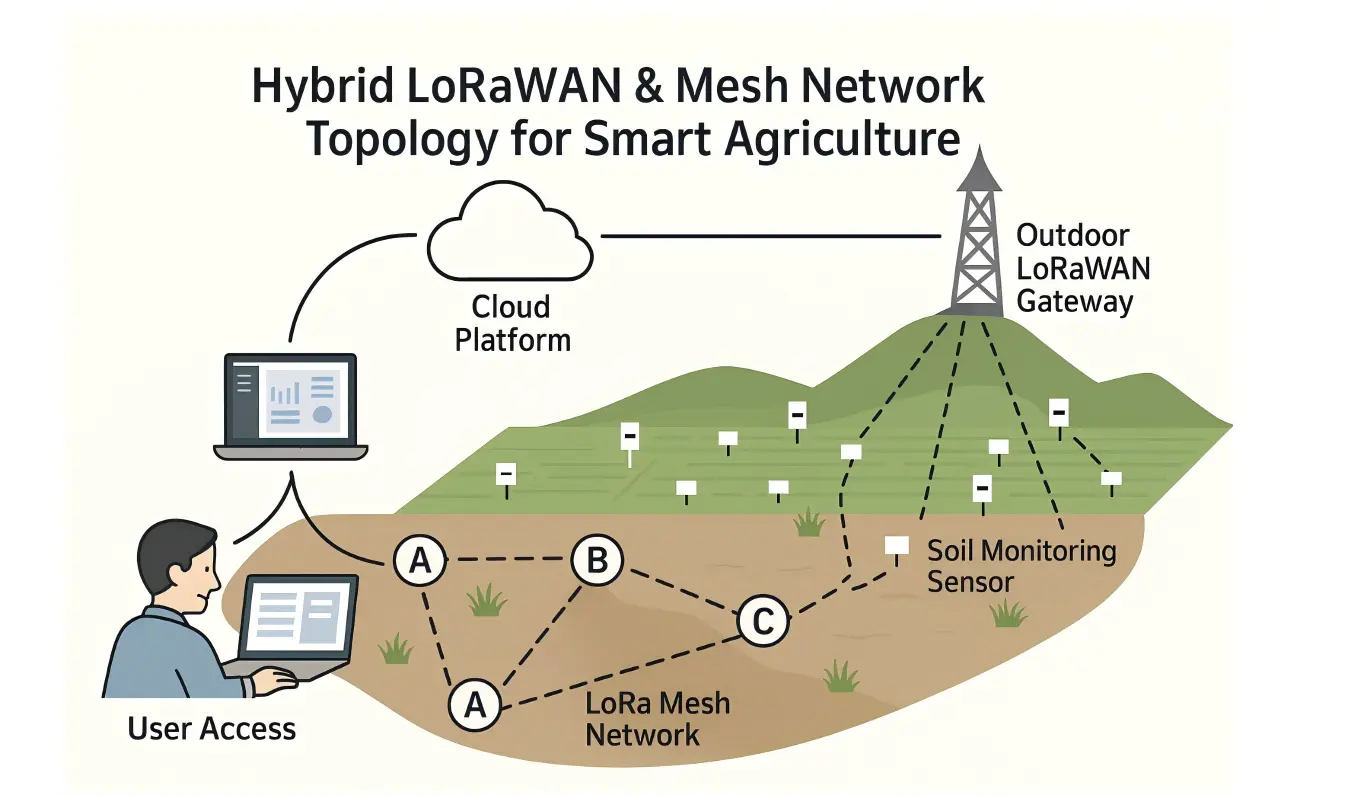
1) Network architecture selection: LoRaWAN (Star Topology)
Application: Due to open terrain and minimal obstruction, LoRaWAN is typically preferred. One or two outdoor gateways installed on towers or central locations can cover several square kilometers, simplifying deployment and reducing system complexity.
2)Extreme power optimization: 3–5 years of maintenance-free operation
Deep sleep: Nodes wake every 30 minutes to transmit data, remaining in deep sleep for over 99.9% of the time.
Efficient communication: Compact payloads (<10 bytes) combined with optimized ADR settings minimize transmission time and power usage.
Hardware selection: Modules based on Semtech SX1262, such as the NiceRF LoRa1262 series, provide sub-1 μA sleep current and low TX/RX consumption.
3)Hybrid Architecture for Complex Terrain
Application:
In mountainous or hilly farms where LoRaWAN coverage gaps exist, compact LoRa Mesh networks can be deployed as supplements. Mesh nodes relay data hop by hop into LoRaWAN gateway coverage, forming a “Mesh + LoRaWAN” hybrid architecture that combines wide-area coverage with effective gap filling.
Severe signal attenuation: Tunnels are RF-challenging environments where conventional walkie-talkies lose connectivity within a few hundred meters.
Extremely noisy environment: TBMs, drills, and ventilation equipment generate intense noise.
Dynamic personnel movement: Continuous communication is required as workers move along the tunnel.
High coordination demands: Traditional PTT systems introduce delays and reduce efficiency.
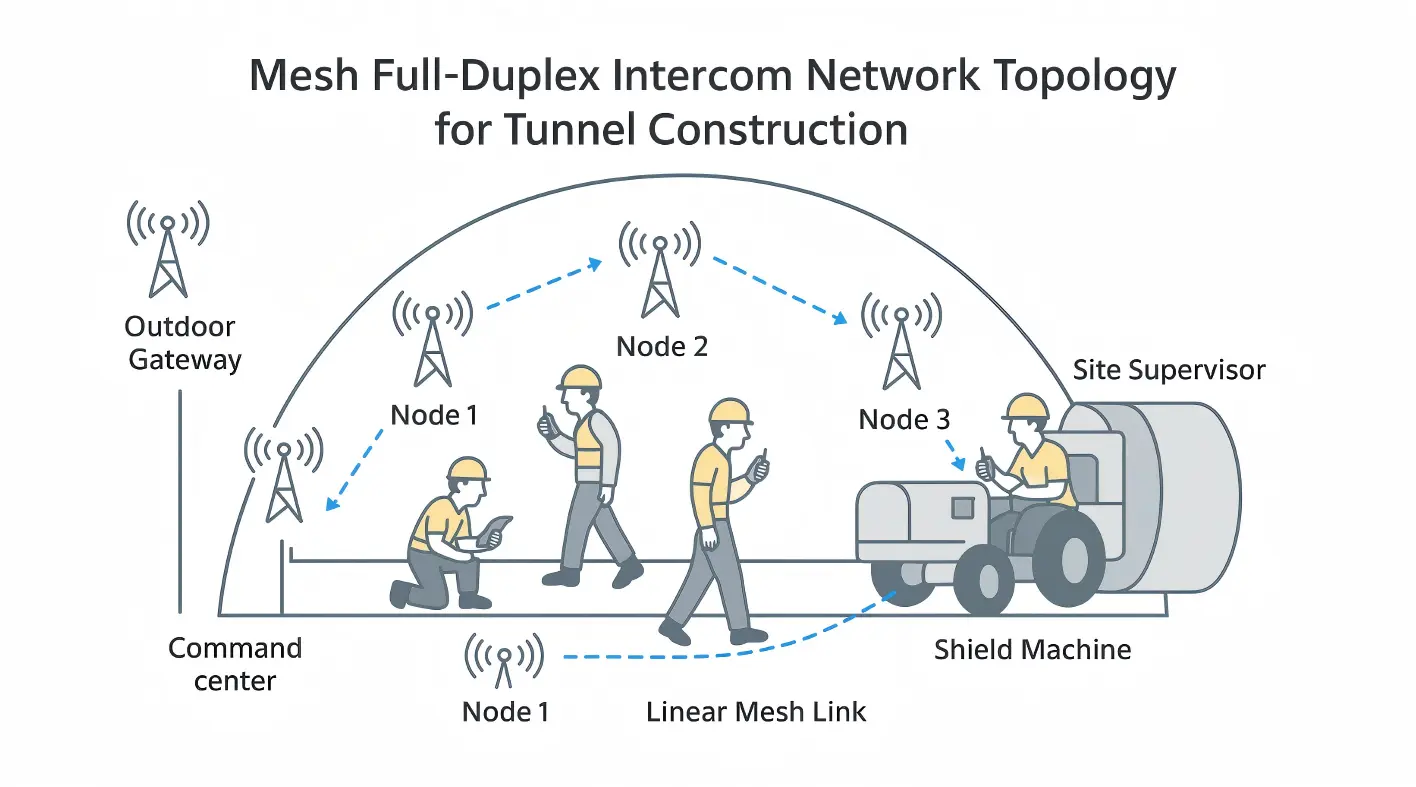
Network reliability: Linear Mesh networking
Mesh relay nodes deployed every 100–200 m form a linear communication backbone. Devices automatically roam between nodes, maintaining connectivity. If a node fails, the Mesh network self-heals by rerouting traffic.
Communication quality: Full-duplex + professional noise suppression
Full-duplex intercom systems allow up to 8 users to communicate simultaneously. Integrated ENC modules suppress up to 100 dB of background noise while preserving clear voice signals.
System integration and compatibility
Mesh intercom modules can be embedded into helmets or dispatch terminals. Dual-mode DMR Mesh modules enable seamless communication between advanced tunnel systems and existing analog walkie-talkies.
This document illustrates practical deployment strategies and design considerations for LoRa and Mesh technologies across different scenarios. For additional technical documentation, module specifications, and application references, please visit the NiceRF official website: www.nicerf.com
 +86-755-23080616
 sales@nicerf.com
Website: https://www.nicerf.com/
Address: 309-315, 3/F, Bldg A, Hongdu business building, Zone 43, Baoan Dist, Shenzhen, China


Privacy Policy
· Privacy Policy
There is currently no content available
Email:sales@nicerf.com
Tel:+86-755-23080616