

 English
How to judge whether the wireless module is broken?
In the process of using thewireless module, you will encounter various situations. The most feared thing is that the wireless module fails to work nor
Feb . 2026
In Internet of Things (IoT) systems, there are multiple ways for devices to communicate data with each other. Some focus on high data rates, such as Wi-Fi; others emphasize ease of use and low power consumption, such as Bluetooth. However, applications that require long-range, low-power, and intermittent data transmission rely on specialized communication technologies.
This article introduces two commonly used modulation schemes for long-range, low-power communication—LoRa and FLRC—and explains how G-NiceRF’ s LoRa2021 dual-band wireless communication module supports both.
LoRa (Long Range ) is a spread-spectrum modulation technology designed to achieve long-distance data transmission with minimal power consumption.
· Strong signal penetration and high interference resistance. In open environments, communication distances can reach several kilometers.
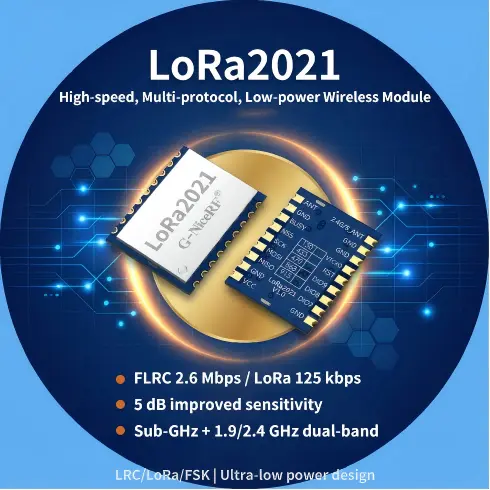
· The LoRa2021 module achieves a receiver sensitivity of up to –142 dBm, enabling the reception of extremely weak signals—one of the key factors for long-range communication.
· When idle or not transmitting data, the module can enter deep sleep mode.
·The LoRa2021 module features a sleep current as low as 2 µA, allowing battery-powered sensors to operate for extended periods, making it suitable for outdoor or hard-to-maintain deployments.
·To ensure long-range communication and low power consumption, LoRa operates at relatively low data rates, typically ranging from several hundred bps to tens of kbps.
·In LoRa mode, the LoRa2021 module supports data rates of up to approximately 125 kbps, suitable for transmitting status information such as temperature, humidity, and location data.
LoRa is well suited for applications with strict requirements on communication range and power consumption, where data payloads are relatively small.
· FLRC (Fast Long Range Communication) is a modulation scheme designed to increase data throughput while maintaining a reasonable communication distance.
· On the LoRa2021 module, FLRC supports a maximum data rate of up to 2.6 Mbps, approximately 20 times higher than LoRa.
·High data rates are suitable for transmitting larger amounts of data in short periods, such as firmware updates (OTA), short audio clips, or low-resolution image transfers.
· Compared with LoRa, FLRC offers shorter communication range and higher power consumption, but it still performs significantly better than Wi-Fi and Bluetooth in terms of range and efficiency.
In practical applications, FLRC can be selected based on throughput requirements and power budgets to achieve an optimal balance between data rate and coverage.
FLRC is suitable for scenarios that require higher data rates while still maintaining a certain level of coverage.
The LoRa2021 module supports multiple modulation schemes, including LoRa, FLRC, FSK, and O-QPSK, with frequency coverage from 150 MHz to 2.5 GHz.
·The module allows developers to select the most appropriate modulation scheme based on application requirements.
·It supports multiple IoT protocol stacks, including Amazon Sidewalk, Wireless M-BUS, Wi-SUN FSK, and Z-Wave, enabling diverse global deployment scenarios.
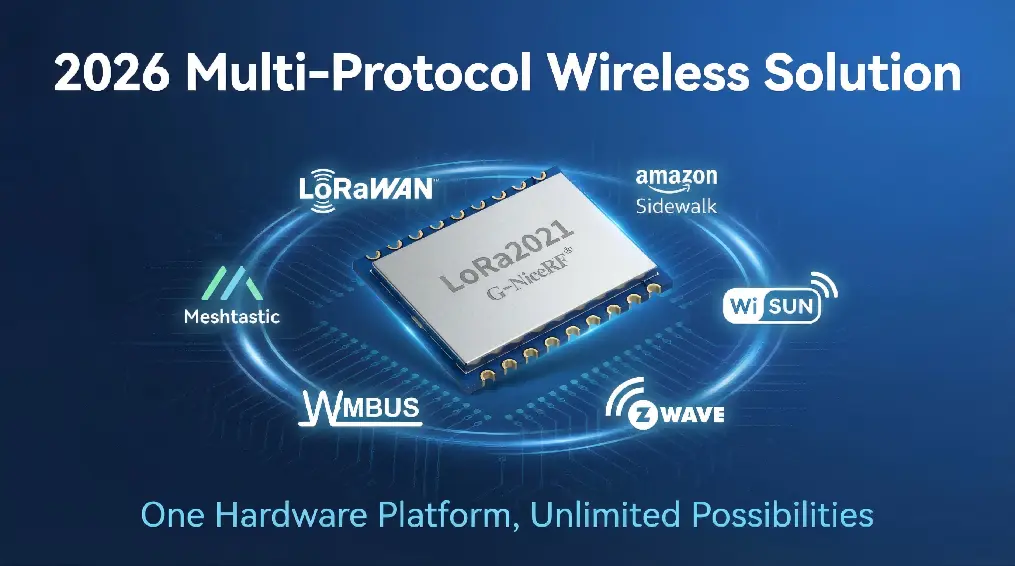
·When applications require long-range and low-power transmission (such as smart water meters or environmental monitoring), LoRa mode can be used.
· When applications require fast data transmission or OTA updates, FLRC mode is an ideal choice.
The LoRa2021 module integrates multiple wireless communication modes into a single hardware platform, providing flexible options that allow developers to optimize communication solutions based on real-world application requirements.
 +86-755-23080616
 sales@nicerf.com
Website: https://www.nicerf.com/
Address: 309-315, 3/F, Bldg A, Hongdu business building, Zone 43, Baoan Dist, Shenzhen, China

Privacy Policy
· Privacy Policy
There is currently no content available
Email:sales@nicerf.com
Tel:+86-755-23080616