

 English
What is the purpose of the wireless walkie talkie module
The wireless walkie talkie module is an important core part of the walkie-talkie. So what is the purpose of the walkie-talkie module and what solution
Jun . 2025
Sub-GHz wireless modules are widely adopted in long-distance communication scenarios due to their advantages such as low power consumption, strong penetration capability, and excellent anti-interference performance. They are especially suitable for complex environments like agricultural monitoring, environmental sensing, smart grids, and underground communication. In these applications, the communication range directly affects system availability and deployment cost. However, with a wide variety of wireless modules available, selecting a Sub-GHz module that offers “long communication distance, low power consumption, and stable performance” becomes a critical consideration during the product selection phase.
Features of Sub-GHz Wireless Communication Technology
Sub-GHz wireless communication technology operates in frequency bands below 1 GHz. It is characterized by long-range transmission, low power consumption, less congested frequency bands, and strong signal penetration. Due to its favorable signal propagation characteristics, Sub-GHz signals typically achieve longer transmission distances than higher frequency bands like 2.4 GHz under the same power conditions. This makes it particularly suitable for wide-area coverage applications such as smart campuses and buildings, metering, fire safety, smart agriculture, and industrial control.
Factors Affecting the Communication Range of Sub-GHz Wireless Modules
Transmission Power: Transmission power is one of the key factors influencing communication distance. Generally, the higher the transmission power, the farther the signal can travel. However, increasing transmission power also leads to higher power consumption, so a balance must be struck between communication range and energy efficiency.
Receiver Sensitivity:
Receiver sensitivity indicates the weakest signal strength a module can effectively receive. The higher the sensitivity, the better the module can maintain efficient reception even under low signal conditions, thereby extending the communication range.
Frequency Band Characteristics:
Different Sub-GHz frequency bands exhibit varying propagation characteristics. For instance, some bands offer stronger signal penetration, making them suitable for use in complex environments, while others experience lower propagation loss, making them ideal for long-distance transmission.
Antenna Design:
Antenna performance has a direct impact on signal transmission and reception. A well-designed antenna can enhance radiation efficiency and receiver sensitivity, thereby improving overall communication distance.
LoRa1120: An Ideal Choice for Long-Range Communication with Low Power Consumption
Multi-Band Support:
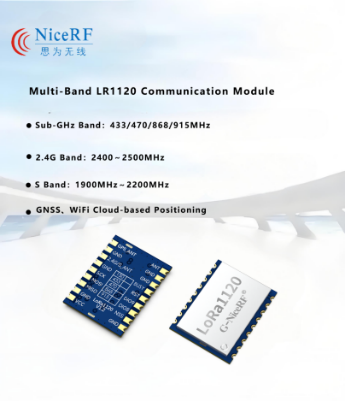
LoRa1120 supports Sub-GHz, 2.4GHz, and S-band frequencies, making it suitable for global IoT communications. The Sub-GHz band offers excellent long-range transmission with receiver sensitivity reaching up to -144 dBm, significantly enhancing weak signal reception. The 2.4GHz band, on the other hand, is better suited for short- to mid-range communication with higher data throughput. The combination of these two bands increases application flexibility.
Satellite Communication Support:
With integrated S-band support, LoRa1120 enables LoRa-based satellite communication, making it ideal for areas without terrestrial network coverage—such as oceans, deserts, and high-altitude regions. This global communication capability is well-suited for applications like cross-border transportation and maritime monitoring.
Low Power Design:
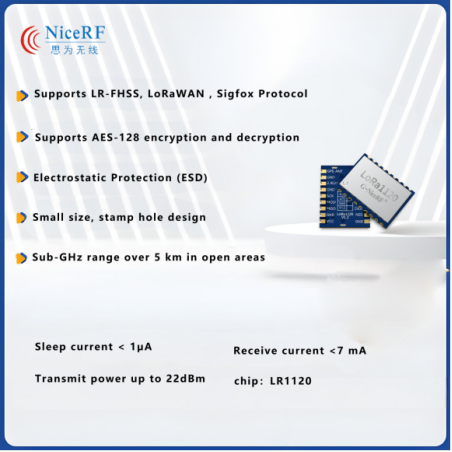
Building on LoRa’s low-power advantages, LoRa1120 maintains consistent power consumption across different frequency bands, supporting multi-year battery life. Satellite communication and positioning functions can operate independently, further reducing overall energy usage—ideal for long-term deployment in battery-powered devices.
Integrated Positioning Functionality:
LoRa1120 features a built-in GNSS scanner and Wi-Fi MAC address scanning capability. Combined with LoRaCloud™ services, it enables hybrid positioning, meeting the needs of scenarios requiring both long-range communication and positioning, such as logistics and asset tracking.
Recommendations for Choosing a Long-Range Sub-GHz Wireless Communication Module
Define the Application Scenario:
Evaluate key factors such as communication distance, environmental conditions, and data transmission rate. For example, urban asset tracking demands strong penetration and anti-interference performance, while remote monitoring in open areas places greater emphasis on long-range transmission capabilities.
Consider Multi-Band Support:
Modules like the LoRa1120 offer multiple frequency bands, allowing selection of the most suitable band for different environments, thereby enhancing communication reliability and range.
Focus on Power Consumption:
To ensure long-range communication without sacrificing efficiency, choose modules with low power consumption. This helps extend battery life and reduce overall system cost.
Pay Attention to Communication Protocols:
If your network requires wide-area coverage or supports a large number of nodes, consider modules that support the LoRaWAN protocol. These offer greater flexibility in network topology and strong compatibility across different devices and systems.
When selecting a Sub-GHz wireless communication module, it’s essential to consider a combination of factors based on your specific application and operational needs. Look for a module that balances long communication range, stable performance, and low power consumption.
If your priority is long-range communication with low power usage and scalability, consider modules like the LoRa1120, which offer LoRa modulation, high receiver sensitivity, multi-band support, and built-in positioning capabilities. In the complex and diverse landscape of IoT applications, the right choice of communication module directly determines the effectiveness and reliability of system deployment.
 +86-755-23080616
 sales@nicerf.com
Website: https://www.nicerf.com/
Address: 309-315, 3/F, Bldg A, Hongdu business building, Zone 43, Baoan Dist, Shenzhen, China


Privacy Policy
· Privacy Policy
There is currently no content available
Email:sales@nicerf.com
Tel:+86-755-23080616