

 English
Which antenna is better for uart rf module?
Generally, the antennas used in conjunction with uart rf modules include spring antennas, rod antennas, and sucker antennas. So which type of antenna
Jun . 2025
The center frequency refers to the antenna's primary resonance point, where its performance is optimal—typically featuring the best gain, impedance matching, and radiation efficiency. It usually lies at the midpoint of the antenna's bandwidth and serves as a core reference in antenna design.
The operating frequency range is the frequency band over which the antenna can effectively transmit or receive signals. Users must ensure this range covers their intended communication frequency. For example, LoRa devices often operate at 433 MHz, 868 MHz, or 915 MHz; thus, the antenna's operating frequency must precisely align with these bands. Otherwise, issues like significant signal loss and unstable connections may occur.
Bandwidth defines the frequency range within which the antenna maintains good performance (For example: VSWR < 2). Different applications have different bandwidth requirements: broadband protocols like Wi-Fi favor antennas with wide bandwidth, whereas narrowband systems like LoRa emphasize precise alignment between the center frequency and the target operating frequency.
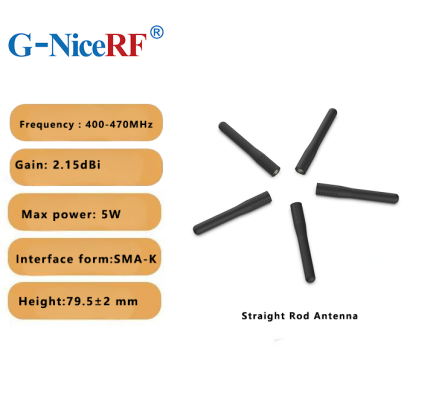
Key Points to Pay Attention To:
The operating frequency must match the module frequency.
Wireless communication systems like LoRa rely on electromagnetic wave transmission at specific frequencies. Antenna design—including size, structure, and materials—is typically optimized for a particular frequency. Only when the antenna’s frequency aligns with the module’s operating frequency can efficient signal transmission and reception be achieved. If there’s a mismatch, several issues may arise: poor transmission efficiency due to power reflection, reduced reception sensitivity, shorter communication range, and even unstable or failed communication.
A wider bandwidth doesn’t mean better performance.
While broadband antennas can cover multiple frequencies, their gain and efficiency at a specific frequency may be inferior to those of a dedicated narrowband antenna. In narrowband applications like LoRa, the key factor is how precisely the antenna’s center frequency aligns with your target frequency (For example, 433 MHz or 868 MHz). Precise frequency matching is essential for achieving long-range, stable communication.
Gain
The higher the gain, the more concentrated the signal energy becomes, potentially extending communication distance—but with a narrower coverage angle. For example, a 3 dBi antenna typically provides wider coverage, making it suitable for indoor IoT nodes. In contrast, a 9 dBi directional antenna is better suited for long-distance point-to-point setups but performs poorly for short-range omnidirectional coverage. Simply put, higher gain means the antenna can focus energy more effectively in a specific direction, thereby enhancing signal strength and communication range in that direction.
It's important to note that higher gain does not mean a stronger overall signal—it reflects a change in how energy is distributed. An antenna does not amplify the total signal power; it redistributes it, concentrating more energy in a particular direction. This is similar to how a spotlight focuses light or how a megaphone projects sound more forcefully in one direction.
For example, if you're using a 433 MHz LoRa antenna with a rated gain of 5 dBi, it means the antenna increases signal strength by 5 dB in its main radiation direction compared to an ideal isotropic antenna that radiates evenly in all directions. This design enhances long-distance communication in the focused direction but reduces signal coverage in other directions.

Gain, Directionality, and Application Scenario Comparison
An antenna's gain not only affects the signal strength in a particular direction but also determines its radiation directionality, making it suitable for different usage scenarios accordingly.
Gain Range | Direction | Application |
0~3 dBi | Nearly omnidirectional | Indoor, short-distance, multi-node environments such as warehouses and offices |
5~8 dBi | Moderate directionality | Urban areas and open spaces for medium-range communication |
9 dBi above | High directionality | Point-to-point long-distance communication, such as tower cranes and remote monitoring |
Polarization
Polarization describes the oscillation direction of the antenna’s electric field vector. The most common types are vertical polarization, horizontal polarization, and circular polarization (left-hand or right-hand). Although it may sound technical, polarization consistency has a significant impact on real-world communication.
When the transmitter and receiver polarization do not match, polarization loss occurs, which can cause signal attenuation exceeding 20 dB—effectively cutting the communication distance by half instantly. Unfortunately, this signal loss is often not due to hardware quality but caused by inconsistent antenna installation angles.
Impedance
Power transfer efficiency in RF systems heavily depends on impedance matching. Each part of the wireless communication link—from module to PCB, coaxial cable, and antenna—is typically designed with a 50 Ω impedance, creating a standardized system for lossless connection between the module and antenna.
If the antenna impedance deviates from the system design value, part of the RF power will be reflected back to the source. This not only reduces the effective transmission power but may also cause module overheating or damage to the power amplifier.
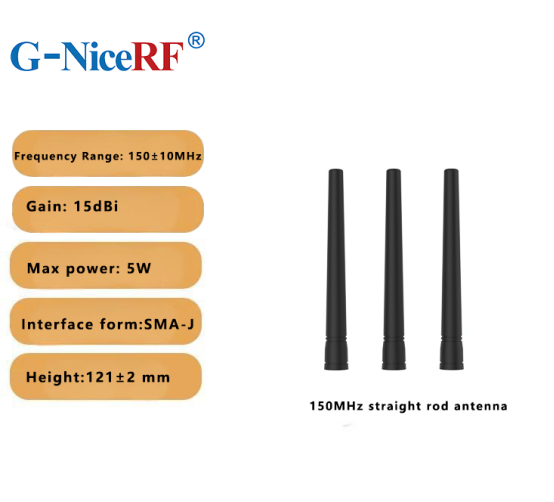
VSWR
Closely related to antenna impedance, VSWR is a crucial parameter that directly reflects how well the antenna is impedance-matched to the RF system. A low VSWR indicates good matching and efficient power transfer, while a high VSWR signals poor matching and increased signal reflection.
Power Handling Capacity
Power handling capacity describes the maximum RF input power an antenna can safely withstand, acting as a “safety valve” to prevent antenna damage or failure. For small patch or embedded antennas, this capacity typically ranges from 100 mW to 1 W; high-gain or outdoor antennas can often handle 10 W or more.
This parameter is especially critical in scenarios such as:
Modules configured for high-power transmission (For example, +20 dBm or above)
Systems with prolonged continuous communication or high duty cycles
Designs involving multiple signal combining or shared antennas
Industrial applications exposed to high ambient temperatures
How to Choose a Reliable Antenna?
Antenna performance is not just about matching the frequency; it involves a comprehensive system engineering approach covering power handling, directionality, materials, and structure. Here are practical and concise selection tips:
First, ensure the antenna’s center frequency matches the module’s operating frequency.
Confirm that the VSWR at the target frequency is ≤ 2.0—lower values are better.
Balance gain and coverage angle according to your specific application scenario.
Maintain polarization consistency, especially in point-to-point communication.
 +86-755-23080616
 sales@nicerf.com
Website: https://www.nicerf.com/
Address: 309-315, 3/F, Bldg A, Hongdu business building, Zone 43, Baoan Dist, Shenzhen, China


Privacy Policy
· Privacy Policy
There is currently no content available
Email:sales@nicerf.com
Tel:+86-755-23080616