

 English


Wireless module electrical performance test report
In order to better guarantee the product quality of wireless modules, NiceRF Wireless sends the wireless modules it produces to the laboratory for ins
Sep . 2025
In today’s rapidly evolving IoT landscape, traditional low-power LoRa modules can no longer meet the requirements of extreme application scenarios. When you need full coverage monitoring across vast farmlands, when you must establish reliable communication links in remote mountainous areas, or when you need to penetrate obstacles in complex industrial environments, a standard 160mW power output becomes negligible.
It was under such demands that the LoRa1121F33 series was born—not just a simple power boost, but a qualitative leap in communication capability. As a company with over 15 years of expertise in the wireless communication industry, we can confidently say that the launch of the F33 series marks a new era for LoRa technology.
Today, let’s dive into its two flagship models: LoRa1121F33-1G9 (Satellite Communication Specialist) and LoRa1121F33-2G4 (Terrestrial Communication Champion). Like twin stars in the sky, they shine with distinct brilliance, illuminating the vast horizon of long-range wireless connectivity.

High-Reliability LoRa Wireless Modules for Long-Range, Complex Environments, and Multi-Band Scenarios
If conventional LoRa modules are considered terrestrial experts, then F33-1G9 is the pioneer of integrated space-to-ground communication. Its standout feature lies in its S-band (1.9–2.1 GHz) satellite communication capability, enabling connectivity in areas without terrestrial network coverage.
1) Series Positioning and Differences
Dimension | LoRa1121F33-1G9 | LoRa1121F33-2G4 |
High-Frequency Focus | S-band (1.9–2.1 GHz), designed for satellite IoT and integrated space-ground communication | 2.4 GHz ISM band, designed for terrestrial high-throughput / low-latency |
Sub-GHz Output | 433/470 MHz: 2 W; 868/915 MHz: 1 W | 433/470 MHz: 2 W; 868/915 MHz: 1 W |
High-Band Output | 1 W @ 1.9–2.1 GHz | 1 W @ 2.4 GHz (30 dBm) |
Receive Sensitivity (Typical) | Sub-GHz: down to –144 dBm; S-band: down to –132 dBm | Sub-GHz: down to –144 dBm; 2.4 GHz: down to –129 dBm |
Frequency Stability | Industrial-grade TCXO ±0.5 ppm | Industrial-grade TCXO ±0.5 ppm |
RF Front-End Enhancement | — | Built-in FEM (PA+LNA), LNA gain ~15 dB |
Representative Applications | Satellite IoT, remote/marine communication, emergency response | Smart city/park IoT, video & image transmission, UAV data links |
When we talk about the “long-range” capability of LoRa communication, the traditional benchmark is based on a power level of 160 mW. With the F33 series delivering 2 W output power, the improvement is not just numerical—it represents a fundamental expansion of application scenarios.
Technological Breakthrough: From 160 mW to 2 W
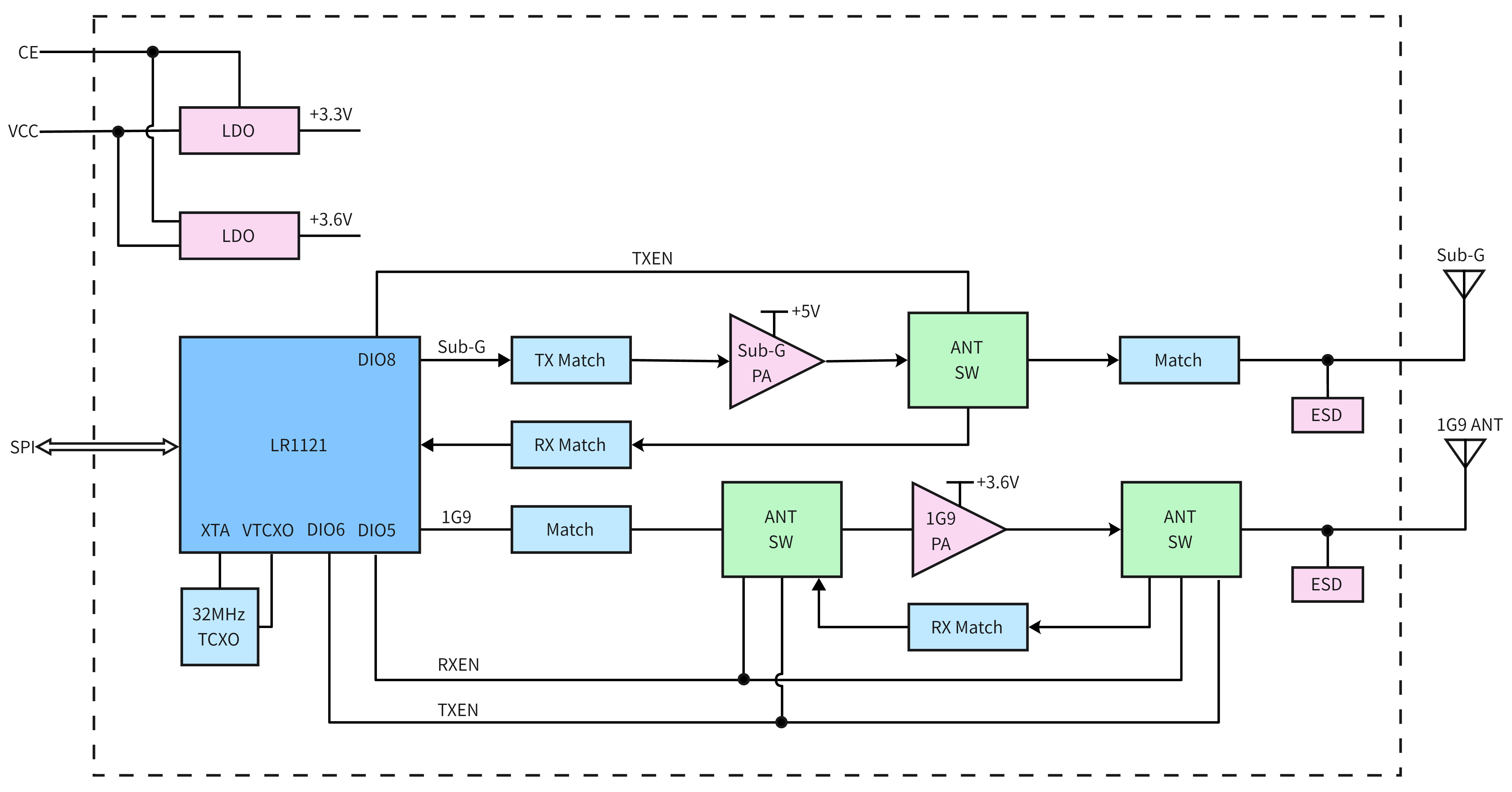
Block Diagram of the Product:
2) Core Features and Parameters
Comparison Item | F33-1G9 | F33-2G4 |
Sub-GHz Power (433/470 MHz) | 33 dBm (2 W) | 33 dBm (2 W) |
Sub-GHz Power (868/915 MHz) | 30 dBm (1 W) | 30 dBm (1 W) |
High-Band Power | 30 dBm (1 W) @ 1.9–2.1 GHz | 30 dBm (1 W) @ 2.4 GHz |
Sub-GHz Sensitivity (Typical) | Down to –144 dBm | Down to –144 dBm |
High-Band Sensitivity (Typical) | –132 dBm (S-band) | –129 dBm (2.4 GHz) |
Modulation / Protocol | LoRa / (G)FSK / LR-FHSS; supports LoRaWAN and private protocols | LoRa / (G)FSK / LR-FHSS; supports LoRaWAN and private protocols |
Security | AES-128 hardware encryption | AES-128 hardware encryption |
Certification Path | Region-dependent (high-power category); experience and documentation available to accelerate approval | Same as F33-1G9 |
2.2 Power Consumption and Supply
Comparison Item | F33-1G9 | F33-2G4 |
Supply Voltage Range | 3.0–5.5 V | 3.0–5.5 V |
Sleep Current | < 18 µA | < 20 µA |
RX Current (Sub-GHz) | ~ < 9 mA | ~ < 8 mA |
RX Current (High Band) | — | ~ 24–29 mA (2.4 GHz) |
Power Levels | Multi-level adjustable | Multi-level adjustable |
3) Frequency Band Advantages and Technical Path
Band | Typical Advantages | F33-1G9 | F33-2G4 |
433/470 MHz | Long coverage, good diffraction, strong penetration | ✅ 2 W | ✅ 2 W |
868/915 MHz | Balanced rate and coverage, regulatory-friendly | ✅ 1 W | ✅ 1 W |
1.9–2.0 GHz (S-band) | Satellite IoT, low interference, global coverage | ✅ 1 W | — |
2.4 GHz | Global ISM, high bandwidth, rich ecosystem | — | ✅ 1 W (FEM enhanced) |
4) Typical Application Mapping
Scenario / Requirement | Recommended Model | Key Reasons |
Satellite IoT / Remote Seas / No Ground Coverage | F33-1G9 | S-band 1 W + Sub-GHz 2 W, wide coverage, low interference, ideal for space-ground integration |
Emergency Response / Disaster Recovery | F33-1G9 | Independent network, robust link, frequency stability under extreme temperatures |
Smart City / Campus IoT (Lighting, Parking, Pipeline) | F33-2G4 | 2.4 GHz high bandwidth + Sub-GHz wide coverage, flexible deployment, controllable site density |
Video / Imaging / UAV Data Links | F33-2G4 | 2.4 GHz 1 W + built-in FEM (PA+LNA), superior throughput |
Large-Scale Agriculture / Pasture | F33-1G9 / F33-2G4 | Sub-GHz 2 W long-range coverage; F33-2G4 preferred for image/video |
Industrial Sites (Strong Interference / Metal Obstruction) | F33-2G4 | High power + LR-FHSS + FEM improves link margin |
5) Link Budget and Power: From 160 mW to 2 W
Comparison Item | Base LoRa1121 | F33-1G9 | F33-2G4 |
Sub-GHz Max TX Power | 22 dBm (~160 mW) | 33 dBm (2 W) @433/470; 30 dBm (1 W) @868/915 | 33 dBm (2 W) @433/470; 30 dBm (1 W) @868/915 |
High-Band Power | 11 dBm (2.4 GHz) | 30 dBm (S-band) | 30 dBm (2.4 GHz) |
Frequency Stability | ±10 ppm | ±0.5 ppm (TCXO) | ±0.5 ppm (TCXO) |
Security / Anti-Interference | AES-128 / LR-FHSS | AES-128 / LR-FHSS | AES-128 / LR-FHSS |
Engineering Note: Compared with 160 mW, the 2 W upgrade improves link budget by ~11–13 dB. Under the same modulation and antenna conditions, theoretical free-space distance increases severalfold; in complex environments, resistance to blockage and fading is significantly enhanced. Adaptive power control is recommended to balance coverage and energy consumption.
6) Mechanical and Interfaces (Selection Highlights)
Item | F33-1G9 | F33-2G4 |
Package / Assembly | Stamp-hole package, SMT-friendly, supports secondary development | 39.0×21.0 mm high-power stamp-hole package, SMT-friendly |
Pin Count | 18 pins (standard breakout) | 18 pins (standard breakout) |
Antennas | Sub-GHz antenna + S-band antenna; supports IPEX / stamp-hole | Sub-GHz antenna + 2.4 GHz antenna; supports IPEX / stamp-hole |
Interfaces | SPI (MISO/MOSI/SCK/NSS), RESET/BUSY/IRQ, VCC/GND, CE enable | Same as F33-1G9 |
Supply | 3.0–5.5 V (high-voltage, high-power) | 3.0–5.5 V (high-voltage, high-power) |
Design Guidelines | • RF trace grounding continuity & return path | • RF trace grounding continuity & return path |
Power and Operation Strategy (Engineering Guidelines)
•22-step adjustable power: dynamically adapt output per RSSI/SNR to save energy at short range.
•Duty-cycle RX with fast wake-up: recommended for long-standby applications.
•LR-FHSS: improves robustness and spectrum utilization in high-interference environments.
•Power design: ensure sufficient supply margin and decoupling during 2 W TX; isolate •PA/FEM and baseband supplies; optimize ground return and heat dissipation.
7) Procurement and Deployment (TCO Perspective)
Dimension | F33-1G9 | F33-2G4 |
Network Dependency | Can operate without ground network (S-band satellite) | Terrestrial network focused, flexible deployment |
Base Stations / Gateways | Fewer (satellite backhaul or long-range aggregation) | Controllable site density (Sub-GHz coverage + 2.4 GHz backhaul) |
Operation & Maintenance | Satellite link cost manageable, low node maintenance | Zero-fee local communication, site maintenance manageable |
Application Fit | Remote, maritime, emergency high-reliability needs | Urban, video, UAV, high-bandwidth applications |
Frequency Band Strengths
F33-1G9 (S-band):
Dedicated band with minimal interference.
Excellent compatibility with LEO satellite constellations (e.g., Starlink, OneWeb).
Balanced propagation and penetration compared with Sub-GHz.
F33-2G4 (2.4 GHz ISM):
Built-in FEM (PA+LNA), LNA gain ~15 dB for enhanced reception.
Supports higher data throughput, ideal for bandwidth-demanding use cases.
Globally license-free ISM band, widely supported ecosystem.
Product Highlights
F33-1G9: 2 W Sub-GHz + 1 W S-band, –144 dBm sensitivity, TCXO ±0.5 ppm, supports LR-FHSS & AES-128; ideal for satellite IoT, emergency, and remote coverage.
F33-2G4: 2 W Sub-GHz + 1 W 2.4 GHz, built-in FEM (PA+LNA), –129 dBm sensitivity; ideal for smart cities, video, and UAV high-bandwidth applications.
 +86-755-23080616
 sales@nicerf.com
Website: https://www.nicerf.com/
Address: 309-315, 3/F, Bldg A, Hongdu business building, Zone 43, Baoan Dist, Shenzhen, China


Privacy Policy
· Privacy Policy
There is currently no content available
Email:sales@nicerf.com
Tel:+86-755-23080616